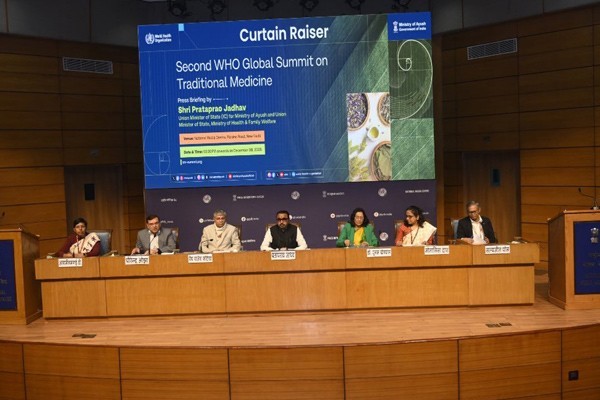
New Delhi, December 9 - India expects representatives from 100 countries to participate in the Second World Health Organization Summit on Traditional Medicine, to be held from December 17 to 19.
The event will bring together ministers, policymakers, leaders of international health organizations, researchers, experts, industry representatives, and professionals, said Prataprao Jadhav, Minister of State for the Ministry of Ayush, during a press conference.
This government agency is responsible for ensuring the development of ancient medical systems such as Ayurveda, Unani, Yoga and Naturopathy, Siddha, Sowa-Rigpa, and Homeopathy.
Jadhav emphasized that the meeting, under the motto "Restoring the balance: The science and practice of health and wellbeing," represents another important milestone in the global collective effort to integrate traditional medicine into the health, happiness, and wellbeing of humanity.
He noted that this aligns with India's vision, which contains the Sanskrit mantra Sarve Bhavantu Sukhinah, Sarve Santu Niramayah, meaning "May all be happy, may all be free from illness, may all see goodness, may there be no victims of suffering."
The Indian minister also praised the ongoing efforts of the Ministry of Ayush and the World Health Organization in planning the Summit and acknowledged the essential role of the media in raising awareness and strengthening public trust in traditional medicine.
He also expressed confidence that the discussions and collaborations resulting from the Summit will guide the world towards a future of more holistic, inclusive, and sustainable healthcare.
Jadhav recalled that a parallel event dedicated to ashwagandha, one of India’s most recognized and scientifically studied medicinal plants, will be organized, highlighting its importance in traditional and contemporary health practices.
He underscored India’s leadership in Traditional Medicine and noted that the establishment of the WHO Global Centre for Traditional Medicine in Jamnagar, Gujarat, in collaboration with the South Asian nation, reflects the growing global confidence in Indian traditional knowledge systems.
Meanwhile, Poonam Khetrapal, Regional Director Emeritus for the WHO South-East Asia Region, noted that the Summit will define a decade-long roadmap for evidence-based, equitable, and sustainable integration of traditional, complementary, integrative, and indigenous medicines into national health systems.
The senior advisor on traditional medicine to the WHO Director-General stressed the need to address gaps in evidence through research, innovation, and regulatory strengthening.