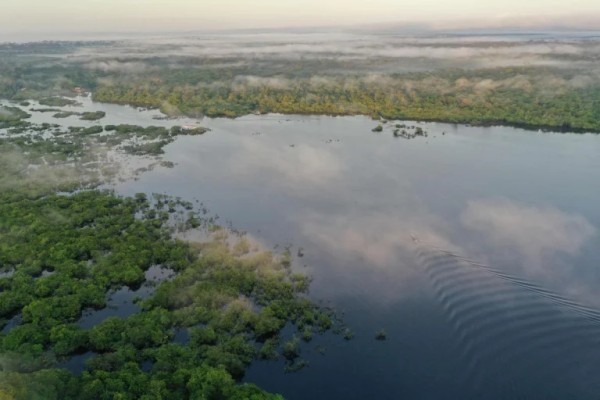
Droughts have wilted crops in Peru, fires have ravaged the Amazon, and hydroelectric dams in Ecuador are struggling to generate electricity as rivers dry up.
Scientists say the cause may be found high above the rainforest, where invisible "flying rivers" carry rain from the Atlantic Ocean to the rest of South America.
A new analysis warns that relentless deforestation is disrupting this flow of water and suggests that the continued loss of trees will worsen droughts in the southwestern Amazon and could eventually lead to these regions shifting from rainforest to savanna, a grassland with far fewer trees and a drier climate.
"These are the forces that truly create and sustain the Amazon rainforest," said Matt Finer, lead researcher for the Monitoring of the Andean Amazon Project (MAAP) at Amazon Conservation, which tracks deforestation and climate threats throughout the basin and conducted the analysis.
"If you disrupt that pumping by cutting down too much forest, the rains stop reaching where they need to go."
Most of the rain in the Amazon begins over the Atlantic. Moist air is pushed inland by constant winds blowing westward along the equator, known as trade winds. The forest then acts like a pump, retransmitting water thousands of kilometers westward as trees absorb water and then release it back into the air.
Brazilian climate scientist Carlos Nobre was one of the first researchers to calculate how much of the water vapor from the Atlantic could pass through and then exit the Amazon basin. He and his colleagues coined the term "flying rivers" at a scientific meeting in 2006, and interest grew as scientists warned that a weakening of these rivers could push the Amazon to a tipping point where the rainforest turns into savanna.
This is important because the Amazon rainforest is a vast reservoir of carbon dioxide that largely drives global warming. Such a change would devastate wildlife and indigenous communities and threaten agriculture, water supply, and climate stability far beyond the region.
Finer's group's analysis found that southern Peru and northern Bolivia are particularly vulnerable. During the dry season, flying rivers pass through southern Brazil before reaching the Andes, precisely where deforestation is most intense.
The loss of trees means that less water vapor reaches the west, increasing the risk of drought in iconic protected areas like Peru's Manu National Park.
"Peru can do everything right to protect a place like Manu," Finer said."But if deforestation continues to disrupt pumping in Brazil, the rains that sustain it may never arrive."
Nobre stated that up to 50% of the rainfall in western Amazon near the Andes depends on flying rivers.
Corine Vriesendorp, science director at Amazon Conservation based in Cusco, Peru, noted that changes are already visible.
"The last two years have brought the driest conditions that the Amazon has ever seen," Vriesendorp said. "The ecological calendars that indigenous communities use—when to plant, when to fish, when animals breed—are becoming increasingly out of sync. Having less rain and more unpredictability will have an even greater impact on their lives than what climate change is already causing.
" Farmers face failed harvests, indigenous families struggle with interrupted fishing and hunting seasons, and cities that rely on hydroelectric power suffer from blackouts as rivers providing energy dry up.
(With information from La Jornada)
Taken from Cubadebate
_large_large.jpg)