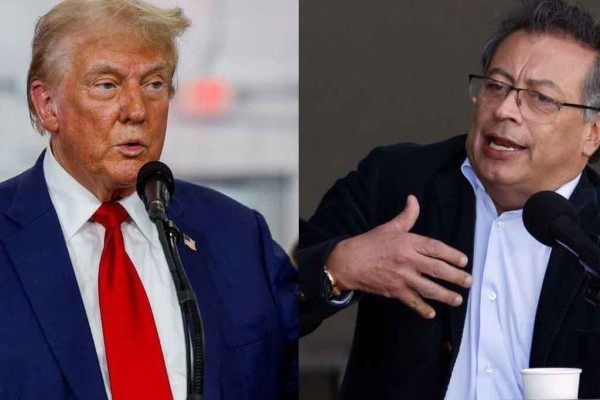
US President Donald Trump, this year's Nobel Peace Prize nominee, may be trying to put out fires in one part of the world, but he's lighting them in another.
Latin America is in the crosshairs. Tensions have not only increased with Venezuela under the pretext of fighting drug trafficking, but the same argument is also being applied to Colombia.
Trump announced Sunday that he will end all US payments and subsidies to Colombia, marking a dramatic escalation in the confrontation with his counterpart, Gustavo Petro.
In a social media post, the Republican president claimed that Petro "does nothing to stop" drug production in his country, "despite large-scale payments and subsidies from the US, which are nothing more than a long-term scam against the United States."
“STARTING TODAY (yesterday), THESE PAYMENTS, OR ANY OTHER FORM OF PAYMENT OR SUBSIDY, WILL NO LONGER BE MADE TO COLOMBIA,” Trump wrote in capital letters in his Truth Social column.
The occupant of the Oval Office even made a gaffe when referring to the name of the South American nation, and this did not go unnoticed by the media here.
"President Gustavo Petro of Columbia is a drug trafficking leader who encourages massive drug production, both in large and small fields, throughout Columbia," the statement said on its platform. The message, which incorrectly mentioned the name of the Latin American country several times, was replaced with another that corrected the error.
Trump and Petro have had public disagreements on issues such as migration and drug trafficking, something that began to escalate after the White House declared war on drug trafficking without congressional authorization, resulting in a series of at least seven attacks and 30 deaths..
Specifically, Petro reported that one of the boats attacked, the one from September 16, "was Colombian, had one engine up, indicating damage, and was turned off. It was presumably in Colombian waters. The person there was a fisherman who hasn't returned home."
He then added that US officials "have committed murder and violated our sovereignty in territorial waters" and identified the fisherman as Alejandro Carranza, a person with no ties to drug trafficking. "We await explanations from the US government," he emphasized.
The U.S. government had already canceled the Colombian president's visa after he participated in a pro-Palestinian protest in New York during his visit to participate in the High-Level Segment of the 80th Session of the UN General Assembly.
Earlier this year, Trump and Petro clashed over the repatriation flights. The Colombian rejected the idea of his compatriots being returned in handcuffs, which he considered undignified treatment.
Trump's announcement yesterday intensified the conflict by adding economic consequences.
According to State Department data, Colombia has reportedly received approximately $210 million in assistance this fiscal year, including approximately $31 million in agricultural support; however, it is unclear exactly what payments Trump was referring to in his messages.
In mid-August, the United States began deploying significant military assets to the Caribbean Sea in operations that, according to the White House, are aimed at combating drug cartels. The forces deployed in the area include eight warships, more than 4,000 troops, including a Marine unit, and 10 F-35 fighter jets.
Petro warned that "a new war zone has opened: the Caribbean (...) is not a war against smuggling; it's a war for oil, and the world must stop it. The aggression is against all of Latin America and the Caribbean."
By the way, writing in all caps on the Internet is commonly interpreted as shouting, and according to etiquette, using such sustained letters can convey a sense of aggression or urgency in communication.
This writing style can have emotional and contextual connotations, which can affect the perception of the message. Therefore, it is advisable to use capital letters sparingly to avoid misunderstandings in online communication.
From Prensa Latina