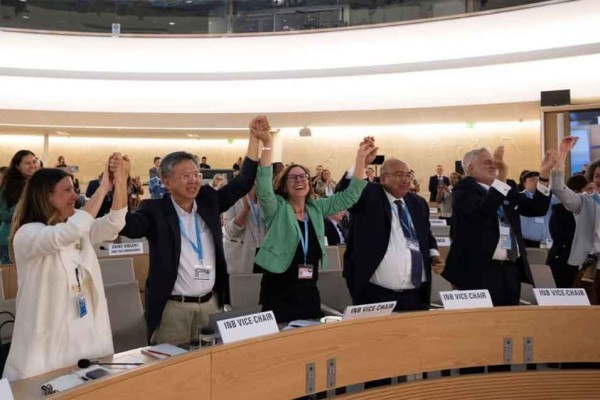
United Nations, Dec. 28 - The UN describes the year coming to an end as a key one for global health, marked by the adoption of the first agreement on pandemics, which strengthens international cooperation and multilateralism in the face of health threats.
Approved at the 78th World Health Assembly, the Pandemic Agreement, together with amendments to the International Health Regulations, aims to ensure a faster, fairer, and more effective response to future health emergencies and promotes more equitable access to vaccines, medicines, and diagnostics.
Additionally, 2025 consolidated itself as a period of significant advances and complex challenges for global health and for the World Health Organization (WHO), according to its Director-General, Tedros Adhanom.
The WHO responded to 48 emergencies in 79 countries and territories, including conflict and prolonged crisis contexts such as Gaza, Sudan, and Ukraine.
Those interventions included support for collapsed health systems, emergency care, and international coordination to protect the most vulnerable populations, according to data from the health agency.
During this period, several countries were also validated for disease elimination, including the recognition of Brazil for eliminating mother-to-child transmission of HIV and becoming the most populous nation in the Americas to achieve this goal.
Moreover, Georgia, Suriname, and Timor-Leste were certified as malaria-free countries, while seven other African nations introduced the vaccine against this disease, bringing the total to 24 countries and benefiting more than ten million children each year.
With WHO support, countries expanded immunization programs against diseases such as meningitis, polio, rotavirus, and human papillomavirus (HPV); more than 86 million girls have already been vaccinated against the latter.
Data from the World Health Statistics 2025 report show that 1.4 billion people now live healthier lives thanks to reduced tobacco use, cleaner air, and improvements in water and sanitation.
There were also declines in HIV and tuberculosis rates, as well as reduced need for treatment of neglected tropical diseases.
At the same time, 2025 was a key year for the non-communicable diseases and mental health agenda, according to the UN.
More than 75 percent of non-pandemic-related deaths are due to these conditions, which disproportionately affect low- and middle-income countries.
Before the year ended, the WHO reinforced its focus on traditional medicine with the adoption of the Global Strategy on Traditional Medicine 2025–2034, which seeks to integrate these practices into health systems based on scientific evidence, safety, and quality.
The WHO Director-General stated that despite such advances, the year was also marked by difficulties, and cuts in international aid threatened to reverse decades of progress.
Nonetheless, Tedros emphasized that the organization remains committed to its founding mission: to ensure the highest possible level of health.
(Taken from Prensa Latina)