

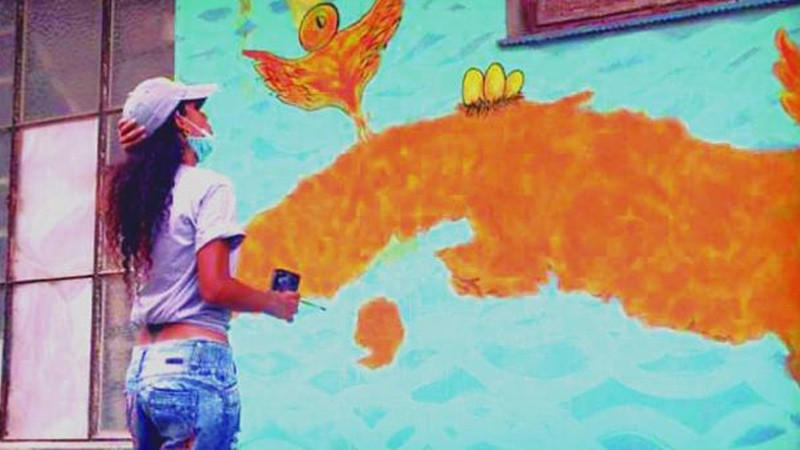
To commemorate Art Instructor Day, Granma approaches professionals who attest to the importance of this role, which merges the artist and the educator.
"To see and imitate, to feel and express," Martí claimed, art is born. With these words, he made clear the value of the impact on the cultivation and subsequent development of that seed that humanizes and distinguishes; and he pointed to the spontaneity of expression and feeling whenever it takes root.
Bringing art to the people was one of the imperatives of the nascent Cuban Revolution. From this noble purpose, which would make the Island an unprecedented cultural stage, there are countless examples, even before Fidel founded the National School of Art Instructors (ENIA) on April 14, 1961, which due to economic difficulties, among other reasons, was halted several years later. The project was resumed as part of the Battle of Ideas campaign, when the Commander in Chief proposed the creation of new Schools of Art Instructors (EIA), and their first graduation took place in 2004.
These marvelous centers have yielded valuable results for the country. A graduate of ENIA, Olga Alonso González, born February 18, 1945, was one of its most cherished disciples. On March 4, 1964, while trying to reach a group of peasants waiting for her classes, the car she was traveling in broke down and overturned. In the accident, the young woman lost her life. In her honor, February 18 was established nationwide as Art Instructor Day.
THE ARTS EMBRACE
Aramís Guillama Quiala is an instructor of Visual Arts at Frank Hidalgo Gato elementary school, located on 19th Street, between 6th and 8th, in the municipality of Plaza de la Revolución. A graduate from 2004, the year of the first graduating class of the EIA, he tells us: "I won't lie, at first I felt full of uncertainties and fears, because for the first time, I was going to face a classroom and turn it into a visual arts workshop...
But experiencing this new journey, Aramís found himself at a loss for words to describe it. I reached the pinnacle of satisfaction seeing how these little disciples learned and shared with me an unimaginable universe of good ideas, centered on the plastic and visual arts; and they did so uninhibitedly, with innocence, with an exquisite technique adhered to and learned in my workshops.
"The art instructor, as the title indicates, must teach what we know, but in order to know, we must first be artists, feel and understand our specialty to be able to transmit it, and that is what sets us apart from other kinds of teaching," he explains. "We study, we prepare ourselves, and then we offer our knowledge to leave a beautiful mark on the spirit of society. The arts embrace hearts and souls, which is why they can positively change some realities of everyday life," he assures.
CARRYING THE "TEACHING BUG" INSIDE
“When I was in ninth grade, I was preparing for the National School of Art, specializing in Theater,” Adriana Toirac, a graduate of the 5th class of EIA, tells us. “In the end, I didn’t take the entrance exam, but I knew theater was my thing. When the option of EIA came up, I saw the doors open because, like my mother, who is a psychopedagogue, I have always liked teaching, and that 'bug' is also inside me; and since I liked teaching and art, it was exactly what I had been waiting for. I took the theater tests and passed,” she recalls.
Adriana currently works on the Arte 92 project, which was created ten years ago and belongs to the Diez de Octubre House of Culture. “Today I teach children from six to ten years old in visual arts workshops. To teach art to children, you have to motivate them, but in the case of painting and drawing, it’s easier because we’re almost born with a crayon in our hand. We need to express what we have inside, and from a very young age, children are painting everything in front of them; they have a need to express themselves that way,” she comments.
The specialist also highlights the benefits for children, even if they don’t end up becoming artists, of having an approach to art, because “that knowledge, those skills they develop, that way of seeing life, will always bring them some benefit. It helps them create new realities, and that’s good so that they don’t settle and choose to do something better,” she tells us.
As if she knew we would inquire about the qualities art instructors must have, Adriana anticipates us: “They have to be very sensitive, first of all, because they are kind of many things—they are artists, but they are educators, and they are also social workers, and even a little bit friends. So sensitivity and empathy in them are fundamental.”
And she summarizes her impressions this way: “And you have to feel love and have a vocation for what you do, what you teach, and what you show. To be able to teach art, you have to feel like an artist. You have to be an artist, and you have to want to leave a legacy for the new generations.”
RAISING CULTURE WITH THEIR KNOWLEDGE
Almost a founder of the EIA, Eduardo García Delgado, with ten years of work at the center as a Spanish–Literature teacher, Yoylán Cabrales Gómez endorses very important issues related to art instructors.
In the conversation we had with him, he spoke about his assessments of these professionals. “I have known how satisfying it is for children and students in general to have had an art instructor in their school; because art, as it has been said, saves.
“Art helps you dream, to have a point of reference, it clothes you in culture, helps you improve in many aspects of everyday life, allows you to see life differently, and relieves many burdens,” he believes.
“I have heard students say that sitting down to paint with the Plastic Arts teacher, or doing theater with their instructor, has freed them from a family problem. They are really important; and maintaining and growing that presence in schools depends greatly on the person who carries it out, as well as the support of institutions so they can develop their work amid scarcity.
“If a Spanish teacher needs to illustrate their classes with a movie or a song, it is the art instructor who should take charge of providing it,” he argues.
Toward his closing remarks, the teacher defends a view that his interlocutors also agree with: “The art instructor is the person who will be responsible for raising that culture which sometimes lies on the ground, and to achieve this, they give the best they have, which are their knowledge and their desire to contribute.”
To be able to teach art, one must feel like an artist.


