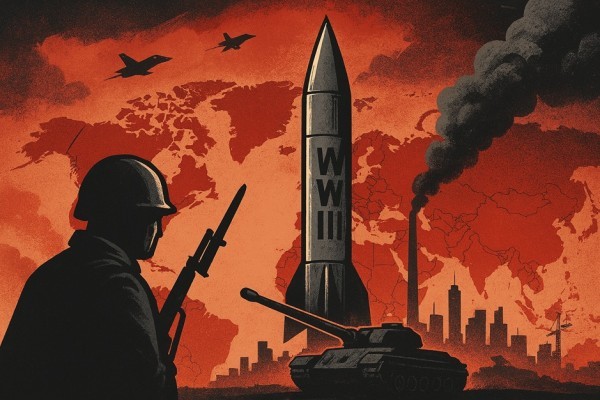
December - Each passing day increasingly points to the likelihood that our generations will have to live through, or survive, World War III. The phrase may sound apocalyptic, but it perfectly fits the contemporary global landscape. Just as in the century of the first and second world wars, the pathological thirst for absolute power by certain empires could be the trigger for today's collapse.
The structural reproduction of violence and wars, which have also become a habit humanity has yet to overcome, makes Hobbes' maxim terribly relevant: "man is a wolf to man." Even worse, it presents it as a truth without better alternatives. A kind of "warlike" determinism; a naturalization of invasions and the general militarization of some to attack and others to defend.
Lenin was not mistaken in outlining "the territorial division of the world among the most important powers" as one of the key features of imperialism (the highest stage of capitalism). Nor was it a coincidence that Marx concluded class struggle is the driving force of history. Both theories are grounded in our realities and complement each other.
Violence, wars, and empires became a triad whose identity reshapes but does not disappear. The United States serves as an example to illustrate the above, as well as to understand how its need to reproduce itself as "master of the world" has conditioned new imperialist periods.
As it is known, great empires have existed and prevailed since ancient times by means of wars, expropriation, and cultural colonization. With the construction of the capitalist economy, military conflicts were commodified to the point of becoming one of the most profitable businesses, essential for the reproduction of the bourgeois elites. In this way, wars are for capitalism, and its systemic crises, points of departure and arrival; cause and consequence.
The fact that military activity has been transformed into a large industry driving an entire "economy of death" reveals that the irrationality to which this system constantly drags us has no parallel in human history.
With the global expansion of capital, the division of the world through territorial invasions combined with plundering and controlling international markets (the universalization of the commodity form), allowing the leaders of these regimes to appropriate others' wealth without necessarily carrying out military invasions on the ground.
Capital has invented "creative" ways to enforce its reign, and anything that implies obstructing it automatically becomes a threat that must be exterminated. Violence and aggression in imperialism are reconfigured but do not cease; on the contrary, it is in its DNA to multiply them.
The (Marxian) "Law of Surplus Value" drives capitalists to fight fiercely not to perish in competition. The commodification of every interstice of reality becomes a condition of existence both for these producers and for the system itself. And it is amid these conditions of permanent "profanation" of all social relations that the revolution in computing and communications took shape. A revolution, at last, has been rapidly transforming the "order" that the two world wars and the collapse of the European socialist bloc had consolidated.
From the conquest of spaces, no longer just physical but virtual as well, new monopolies for digital communication emerged. New types of empires—the "virtual surveillance" empires—incorporated the free collection of data for buying and selling, imposing a sui generis dynamic on the capitalist mode of production.
Whether described as "technofeudalism" or as another stage of imperialism (without trivializing the definition of each here), the struggle for the division of the world morphs and worsens. Contemporary conquest can become cybernetically eternal, unlike when it was only confined to finite natural resources or lands that had to be redistributed again and again.
It is tremendously interesting to perceive how political power (economic, cultural, ideological, etc.) has shifted today both subjectively and objectively. As a result, we could affirm that this phenomenon of confrontation between the old power and the latest generation power is provoking a kind of struggle within capitalism itself and among its main agents. Let us say, between States with all their tentacles (in a Gramscian sense) and information and communication transnational corporations. The latter are pioneers of novel forms of colonization.
If the theory of those who interpret recent transformations associated with the mode of capital acquisition as the transition from capitalism to technofeudalism proves true—that is, as a transformation from one mode of production to another—this dispute within the system has strong political, ideological, and above all, hegemonic consequences for the States.
We could recall, for example, that during Trump's first term, the platform Twitter—which was even less powerful than it is today—sanctioned the President of the United States by suspending his account on this network, thereby cutting off his access and interaction with his millions of followers on it. Who controls or oversees the usual controllers these days?
The communication monopolies and, more recently, those of artificial intelligence lead the new partitioning of the world; a division that is ostensibly predominantly cognitive and virtual. We are in the era of imperialisms 2.0 (as complex as they are similar in their diversity), a sort of "reloaded" version of the one Lenin defined at the beginning of the twentieth century.
Today, these imperialisms encompass: the normalization of armed attacks, military interventions, and the massacre of entire peoples; the exploitation (by minorities wielding absolute power over the rest) of our lands, natural resources, and human beings, as well as the control of international markets; the technological and informational revolution that catalyzes cultural colonization, the universalization of frivolity, social paralysis—except for the expanded consumption of goods—and psychological domination. All of this is interconnected, conditioning a mindset that accepts the described state of affairs as the only possible outcome, leading to the pulverization of the planet, humanity included. The spectacle industry fulfills the role of bolstering a subjectivity that approves of destroying us rather than saving us through revolution.
In this geopolitical scenario, alongside the war in Ukraine and the intensification of the extermination of Palestine—without dismissing other conflicts—there are also the latest threats to invade Venezuela. Deliberately, the United States government has increased its hostility in our region (declared a "Zone of Peace"), with a policy proudly calling itself "Trump’s Corollary to the Monroe Doctrine."
Under a series of illogical pretexts, as it has done many times with other nations, the United States has declared war (on a military level) on Venezuela. This aligns with its historical stance in Latin America and its dispute with Cuba (where the economic, commercial, and financial blockade has marked the policy of the Yankee empire). However, it would not hurt to add to the usual reasons why it resorts—once again—to armed violence for the division of the world, the one concerning its internal hegemonic contradictions. The struggle between powerful, opposing economic forces: the power represented by Trump versus the new power in the hands of the platforms that dominate digital infrastructures and data production worldwide.
Without a doubt, if we want to find explanations for the irrational stances that have brought us to the brink of mass extermination, it will—necessarily—be necessary to return to studies on imperialism (or better yet, the imperialisms).
The outlook could not be more discouraging. If the warning with which this text begins comes to pass, World War III—unlike its predecessors—would trigger a nuclear conflict, the consequences of which would be total extermination. Like in Hollywood movies, but worse; without spaceships or superhumans (and not in the Nietzschean sense).
The usual resistance of our peoples will not be enough unless it leads to the anti-imperialist revolution. Just as Fidel understood early on, as long as empires do not disappear, the “philosophy of dispossession” and war will not vanish for the majorities, and a “true stage of progress” for humanity will not be possible. The key to salvation remains present in internationalism, in solidarity, and in the unity of the oppressed. It is a matter of life or death: imperialism must be definitively defeated; there is no room for new updates.
(Taken from Cubadebate)