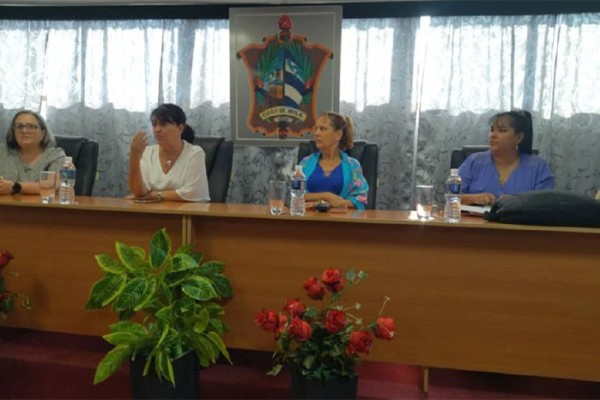
The advantages of having the Transparency and Access to Public Information Law were highlighted by Adianez Taboada Zamora, Deputy Minister of Science, Technology, and Environment (Citma), during recent exchanges with governments and organizations in the central region of the country to discuss the implementation of this legislation.
Taboada Zamora, also a member of the National Assembly of People's Power, emphasized that this legislation will provide the strategic framework for organizing the relationship between current legal provisions and the effective fulfillment of the obligations of state bodies and other entities responsible for providing public information for the purpose of achieving greater transparency.
She highlighted the contributions to effective accountability and the strengthening of citizen rights enshrined in the Constitution of the Republic of Cuba.
The Law will foster a culture of transparency among obligated entities and facilitate the right of access to public information, as it will generate citizen confidence by establishing simple and expeditious ways to obtain data, thereby facilitating greater dissemination of information without prior request.
It will also encourage the responsible use of content, the use of information and communications technologies, and the protection of personal data, as revealed during recent debates in the provinces of Villa Clara, Sancti Spíritus, and Ciego de Ávila.
Transparency will allow people to be informed about government decisions and actions, which will foster more active and informed participation and build trust in public institutions, as citizens will be able to verify that actions are carried out fairly and legally.
In such circumstances, there will be greater opportunities to detect and prevent acts of administrative corruption.
Public officials will have more and better-quality information for decision-making, which will improve the effectiveness of government policies and programs.
Making public information accessible is essential for citizens to better understand the revolutionary government's decisions, several participants in the meeting in Ciego de Ávila agreed.
The proposed law considers the highest state bodies, agencies of the Central State Administration and their subordinate and affiliated entities; national, provincial, and municipal agencies; and national companies to be obligated subjects.
This category includes local organs of People's Power, mass and social organizations, and all structures that provide services to the population or receive public funds, including both individuals and legal entities.
The regulations establish the right to access and consult public information, when it is transparent, which includes the right to receive and disclose it, provided it does not fall within the established exceptions.
For their part, the obligated entities will ensure the implementation of the provisions through procedures that guarantee the exercise of the right of access and the dissemination of timely, truthful, understandable, up-to-date, and complete information, disseminated in the most appropriate and accessible formats for society.
They also have a duty to promote and foster a culture of transparency in the exercise of their public functions, as well as citizen participation and accountability.
Cuba was one of the few Latin American countries without such a legal provision, which confirms the need and supports a development process based on the analysis of 11 decree laws and eight policies that address the issue from different perspectives.
The drafting committee also considered 123 legal frameworks on transparency and access to public information, 33 of which are laws from Latin America and 28 from the Caribbean region.
Meanwhile, Citma will be responsible for compliance with the provisions of this regulation, given that among its five functions is directing and coordinating the National System of Document Management and Archives, established more than 20 years ago, demonstrating its commitment to the nation's documentary heritage.
This institution's track record guarantees the law's enforcement, which will involve training, advisory, and oversight activities, in addition to annual monitoring by the National Commission for Historical Memory of compliance with the established provisions.
Taken from the Cuban News Agency (ACN)