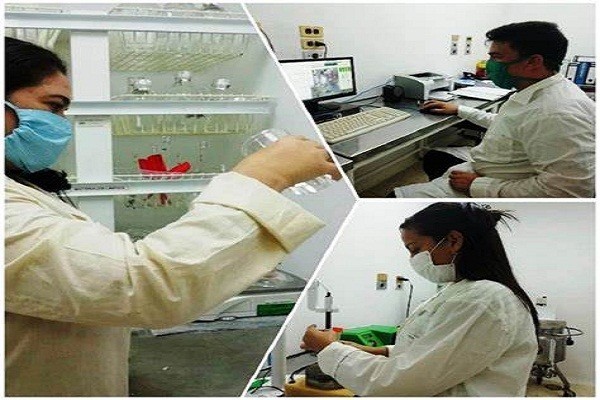
Holguín.— Charcoal, a millennial legacy, is experiencing a rediscovery by the healthcare system of this province. In its dark and porous structure, a balm was found for various skin conditions, inflammatory diseases, and respiratory system ailments.
It was Dr. Yunelis Pérez Concepción, a specialist in General Integral Medicine and Physical Medicine and Rehabilitation at the Octavio de la Concepción y de la Pedraja Pediatric Hospital, who paved the way through innovation so that the healing particles of activated charcoal could be seen in all their potential.
Before receiving last year the Award for Greatest Economic and Social Impact from the National Association of Innovators and Rationalizers, Yunelis had been dedicated for almost a decade to analyzing the almost magical power of activated charcoal poultices in the field of rehabilitation.
She explains that she was aware of the use of carbotherapy as an alternative treatment in other countries, but it was with her own daughter that she verified its value. “I applied it to her during a case of lymphangitis, and the progress was very good, so I decided to bring that knowledge to health services.”
Then happiness quickly followed in the Rehabilitation Room of the Holguín Pediatric Hospital. “The new experience was with a three-year-old girl who had not walked for six months due to knee synovitis. We began applying charcoal poultices and by the fifth day she was walking perfectly,” she recalls.
Many more gratifying moments would follow, to the point that currently more than 10,000 people have been treated with charcoal poultices, which are applied for different periods of time on the affected areas of the body.
“We have many interesting anecdotes. For example, we treated an 88-year-old patient with anthrax, a very difficult condition to work with. With the use of charcoal poultices, we managed to clean the area and avoid a surgical intervention.
“Also, during the peak of COVID-19, at the pediatric hospital we applied this treatment to children with bronchiolitis and bronchitis, and their recovery was faster than those who had not received it. The parents were very grateful.”
The doctor emphasizes that activated charcoal acts as a biological purifier thanks to its ability to adsorb molecules in liquid or gaseous media. Thus, “when we use it topically or transdermally, that is, through the skin, we manage to cleanse the interstitial space of the affected area. This mechanism has allowed us to use it successfully in various inflammatory processes and even in painful sprains and fractures.”
She highlights that they are working to establish an official protocol for the treatment of synovitis with activated charcoal. “The research began at the Alcides Pino polyclinic, where we have treated around 485 cases with an effectiveness of over 95 percent. We already have a residency thesis that supports the method,” she points out.
Carbotherapy has borne double fruit. On the one hand, it has saved millions for the healthcare centers where it has been generalized, by being able to move the treatment to the home, and what is even more valuable, the profound satisfaction of healing. As the doctor states, her greatest reward lies in restoring well-being with an element as simple and harmless as charcoal.