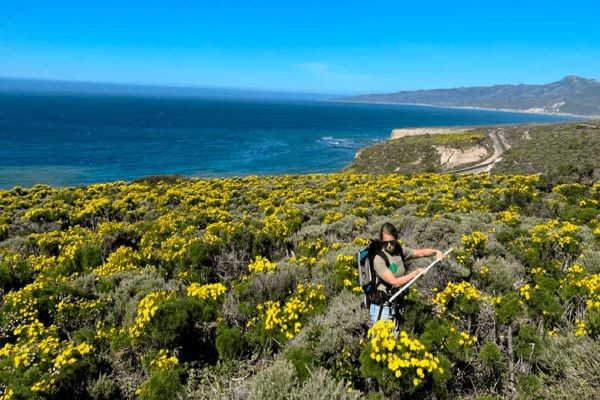
Washington.— New studies using instruments on aircraft and from space employ color to track the seasonal cycles of flowers.
According to NASA, these promoted investigations are important for understanding how rising temperatures and changes in precipitation patterns could affect ecosystems.
The results suggest that this is a potential new tool for farmers and natural resource managers who depend on flowering plants, the source specifies.
Based on this, scientists examined hundreds of hectares of nature reserves this year using technology created by NASA's Jet Propulsion Laboratory (JPL) in Southern California.
The instrument, an imaging spectrometer, mapped the countryside across hundreds of light wavelength bands, taking images of flowers as they bloomed and aged over the course of months.
David Schimel, a JPL research scientist, stated that this is the first time such an instrument has been deployed to consistently monitor vegetation throughout the growing season, making it a “first-of-its-kind” study.
In this way, scientists are analyzing more closely the relationship between plant life and the seasons—known as vegetation phenology—to understand the impact of rising temperatures and changes in precipitation patterns on various ecosystems.
For many plants, from crop species to cacti, flowering is synchronized with seasonal changes in temperature, natural light, and precipitation.
According to NASA, the results open the door to more aerial and space-based studies of flowering plants, which represent around 90 percent of all plant species found in soils.
Fruits, nuts, many medicines, and cotton are some of the staples obtained from these types of species.
Yoseline Angel, the study's lead author, expressed that one of the ultimate goals would be to support farmers and natural resource managers who rely on these plants along with the insects and other pollinators in their environment.
(Taken from Prensa Latina)

_large_large.jpg)