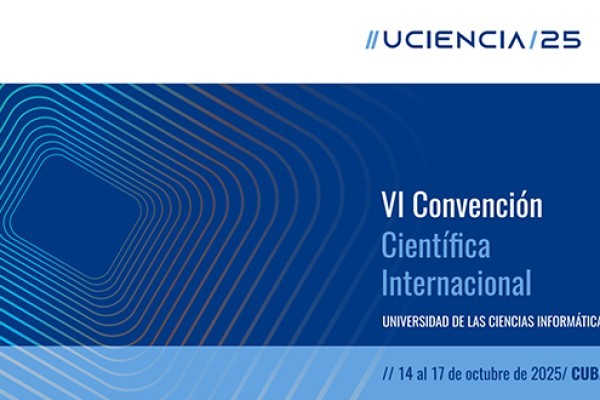
The 6th UCIENCIA 2025 International Scientific Convention, to be held from October 14 to 17 at the Meliá Internacional Varadero Hotel, marks a significant evolution by reflecting the dynamic and interdisciplinary nature of computer science.
Among the main new features is the inclusion of the International Symposium on Digital Health in the scientific program, which includes two new workshops: the 1st International Workshop on Digital Transformation in Health, with prominent participation from representatives of the Pan American Health Organization (PAHO) and the World Health Organization (WHO); and the 1st University of Computer Sciences-University of Leipzig Workshop on Biomechanics and Sport, where a new joint research project between the two academic institutions will be presented.
Dr. C. Yunia Reyes González, Director of Science, Technology and Innovation at the University of Informatics Sciences (UCI), noted that emblematic events such as the International Congress on Artificial Intelligence and Pattern Recognition (IWAIPR), which is now in its ninth edition, are consolidating. The scientific session on Wednesday, October 15, will be dedicated to the presentation of the Consortium for Artificial Intelligence in Cuba, bringing together universities, organizations, and state and non-state companies in the country.

Dr. C. Yunia Reyes González, Director of Science, Technology, and Innovation at the University of Informatics Sciences (UCI). Photo: Courtesy of the interviewee
She specified that the focus on education will be significantly strengthened, with international workshops on Computer Science Training, Virtual Education, Language and Technology, and the University and Society Symposium, emphasizing that technological development must be inextricably linked to the development of human capital.
This year's event also features a virtual participation space through the PICTA platform, where audiovisual materials from the main activities will be available.
When asked about the event's impact on the country's scientific development, the executive emphasized that the UCIENCIA convention has established itself as one of the most important scientific events in the field of computer science in Cuba.
"Each year, we strengthen and strengthen our ties of cooperation with professionals from universities, research centers and institutes, entrepreneurs, and representatives of the information and communications technology (ICT) industry, both in Cuba and around the world," he noted.
In this regard, he emphasized that UCIENCIA provides a platform for presenting the main results of scientific research and Research, Development, and Innovation (R&D&I) projects, which have a significant impact not only on the scientific field but also on the country's economic and social life. These results directly contribute to the strategic axes and sectors of national development, with an emphasis on telecommunications and information technology and the biotechnology and pharmaceutical industries.
She also highlighted the presentation of technological solutions that contribute to the development of the digital agenda and the implementation of the Cuban Artificial Intelligence Strategy.
She emphasized that the event is conceived as a space for scientific debate, fostering professional growth, human capital development, and capacity building for the nation's sustainable development.
In particular, he praised the impact UCIENCIA has had on Cuban universities and their substantive processes. "This event has established itself as a fundamental pillar for fostering a culture of research, innovation, and internationalization within the institution," he stated.
She added that UCIENCIA reflects effective coordination with university extension, disseminating the community's scientific work and strengthening institutional communication through specific promotional strategies. The very design of its scientific program demonstrates a coherent integration with university processes.
The importance of the professional training process featured prominently in the analysis of the Scientific Committee's president, who announced the holding of a symposium dedicated to the exchange of experiences and best educational practices, aimed at enriching curricula, teaching methods, and the use of new tools in university teaching.
"The topics covered in each edition directly correspond to the University's scientific research, ranging from specific areas of computer science—such as artificial intelligence, cybersecurity, medical informatics, scientific computing, software engineering, human-computer interface technologies, and information systems and digital transformation—to the training of computer science professionals and the challenges and social impacts of information and communications technologies," he noted.
This event at the University of Computer Sciences is the ideal venue to showcase the research work of professors, professionals, researchers, and students. Experiences related to R&D&I projects associated with national, sectoral, and institutional and business priority programs will be shared.
In addition, it will foster discussion on the results of research developed in diploma, master's, and doctoral theses, and will promote scientific exchange around technological solutions generated by the UCI's network of software development centers.
One of the crucial topics presented by Reyes González is related to the response that UCIENCIA 2025 will provide to the demands of Cuban society through science and innovation. He emphasized that the design of the scientific program constitutes a direct response to these demands. The Artificial Intelligence Congress and the symposia on Digital Health, Digital Transformation, Training for Computer Sciences, and University and Society, as well as each of the workshops that comprise them, are aligned with national priorities such as the development of the biotechnology industry, ensuring technological sovereignty, and advancing the digital transformation of Cuban society.
Regarding the organizing committee's aspirations, she commented that in this edition—and in future ones—it aims to position UCIENCIA as a regional benchmark scientific event in computer science, not only for its academic rigor, but also for its ability to encompass everything from basic research to concrete applications in strategic sectors such as health, industry, and education.
She highlighted the challenge of strengthening and expanding collaboration with internationally renowned universities and centers in the ICT sector, fostering strategic alliances that promote the creation of cooperation networks and the development of new research projects.
The aim is to position the debate on the ethical and social role of technology and to promote the development of artificial intelligence, cybersecurity, and digital transformation with a deeply human approach and commitment to inclusive development.
The VI UCIENCIA International Scientific Convention is an ecosystem where academia, industry, and government converge and interact to translate knowledge into concrete solutions that contribute to building a digital and innovative Cuba.
Taken from Cubadebate