Since she was a child, Iris Betancourt Téllez learned to look beyond the visible. She said that the answers were hidden in the silences, where only the curious persevere. Her teachers instilled in her to see science as a tool to transform realities. From then on, the noble daughter of peasants, born in the Segundo Frente Oriental, land of beautiful epics, focused her vocation on understanding and probing what others would accept without question.
At the Vocational Polytechnic Institute of Exact Sciences (IPVCE) Vladimir Ilich Lenin — that school many remember as a hotbed of possible dreams — she realized that science does not fit inside a test tube. It revealed itself to her as a way to serve.
Those days among laboratories and blackboards taught her that curiosity alone is not enough: the will to transform is necessary. When she graduated in Pathological Anatomy, her path branched toward the mysteries of veterinary medicine. She confronted the hemorrhagic syndrome and sudden death in cattle with the obstinacy of someone who does not accept the inexplicable.
Those investigations led her and her team to receive the Álvaro Reinoso Award. Later, in Leningrad, she defended her doctoral thesis on changes in the glands and intestines of newborn calves. Amid slides and tissues, she discovered that the study of life is also a way to understand vulnerability.
SETTING THE COURSE
Upon her return, fate had another scenario in store for her: the leadership of several scientific entities. First was the then Higher Institute of Agricultural Sciences of Bayamo (now University of Granma), and later the Jorge Dimitrov Agricultural Research Institute. However, her longest tenure leading an institution was at the Territorial Delegation of the Ministry of Science, Technology and Environment (Citma) in Granma, where she served as delegate.
"Leadership requires sacrificing hours that you could dedicate to publishing articles or deepening a study," she confesses.
Iris Beancourt Téllez led the Granma Scientific Hub from its founding, where she learned that development is not imposed: it is persuaded. Speaking of Iris during her time as Citma Delegate in Granma is to speak of a woman who knew how to unite wills.
"I have always been accompanied by a good team of workers and managers, bound by camaraderie, respect, and support during difficult times."
Iris always knew how to listen, trust, delegate responsibilities, and demand effort—always leading by example. For 25 years, she was a deputy to the Parliament and also a member of the Council of State. There, among decrees and debates, she remained the same woman who had learned from peasants to call things by their name, without beating around the bush.
She participated in the rehabilitation of the Cauto Basin, a project involving several provinces and ministries. She remembers it as a silent epic: men and women united by a single purpose under the eastern sun.
THE CHALLENGES OF THE COMMANDER
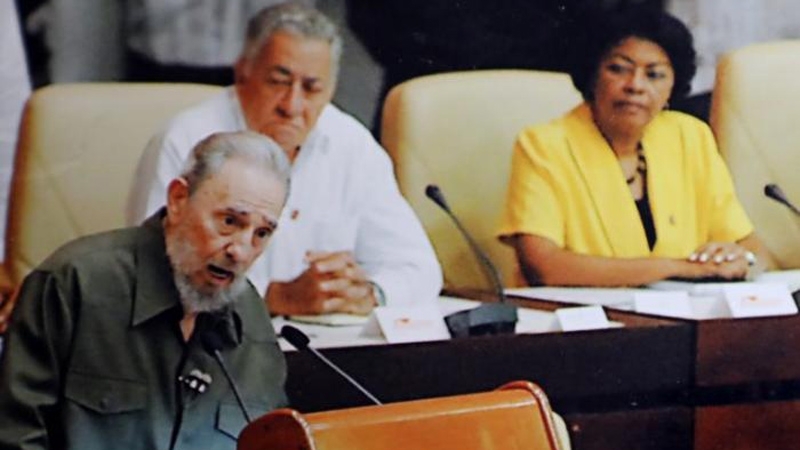
"Being close to the Commander in Chief was one of the greatest gifts life has given me," she says, recalling her encounter with Fidel in 1992, when scientific hubs began to be established in Cuba with the goal of integrating efforts from the knowledge sector and the productive sector to promote the achievement and widespread application of scientific results.
"Practically the year was coming to a close, and Granma had not yet finalized its plan. Fidel told the then Minister of CITMA, Rosa Elena Simeón Negrín: 'I am going to tell you how the Granma Scientific Hub will be,' and he himself detailed on a piece of paper the programs it would address. To my surprise, I was appointed coordinator of the hub.
"At a workshop sharing experiences, where I would appear before his enigmatic figure for the first time, Fidel paused and asked: 'Has the Granma Hub finally been established? Did you invite the comrade? Where is she?'
"Of course, I stood up so he could see me. It was a brief moment, but unforgettable and meaningful.
"Later, I went on to lead Dimitrov. By then, I felt overwhelmed with work and spoke to Rosa Elena about delegating the direction of the Hub to other colleagues. She told me:
"'Well, out of respect, I have to consult Fidel first, because he was the one who proposed you. So if you want, tell him you don’t feel able to continue with the task.'
"I told myself, no way, not for anything in the world! I will do it until I retire. And that’s what I did. It was a personal commitment to the Commander."
That loyalty — not just in words but in action — explains why many describe her as a "woman of the State and the people." Her leadership was born from a deep sense of belonging. In photos, she can be seen walking among technicians, researchers, and farmers; always alongside them, listening and advising.
She devoted 22 years to teaching, and that fills her with as much pride as her leadership responsibilities. "I have guided minds brighter than mine. I have trained generations of cadres better prepared than I am, and that makes me proud," she confesses without false modesty.
There is no nostalgia in her voice, only satisfaction and pride. She knows that her greatest legacy lies in those who today maturely hold the reins of science in the provincial delegation.
Although retirement has come, Iris does not see it as an end. "As long as I have lucidity, I will continue supporting young people and my team as much as possible."
She says this firmly, and one understands that her story cannot be confined to a farewell. She continues to collaborate as a CITMA specialist, advising a new generation of leaders who were trained under her guidance.
When asked if she feels there is still something left to be done, she smiles with that mix of humility and responsibility that characterizes her: "What has been done is little compared to what remains to be done."
For Iris, science does not end in the laboratory or specialized publications. It must translate into well-being, into concrete results that improve the life and economy of the region. That is why she insists that "there is still a lack of systematization in the application of scientific results."
Her thinking, far from fading, becomes a compass. Those who listen to her understand that her confidence in the new generations remains intact. Her words flow naturally, as if she were talking under an almond tree, among anecdotes and measured laughter, recalling names, laboratories, trips, and projects that marked decades.
Hers is not a sunset, but a transition. In the story of Iris Betancourt, our "eternal delegate," science has been both path and destiny. Her journey continues without farewells, like a light that does not go out but guides from new horizons.