"We face intense work ahead. No one should expect easy or immediate solutions. The path is one of struggle, creation, and intelligent resistance, but we are supported by reason, moral strength, and a heroic people as our greatest inspiration."
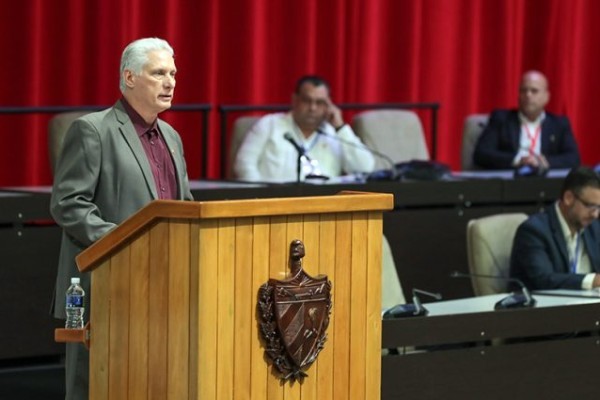
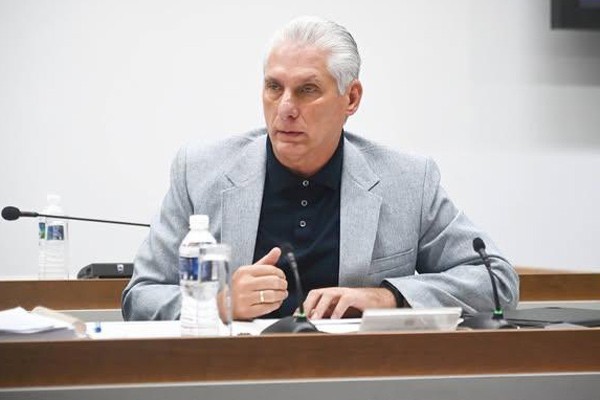
This is how the First Secretary of the Central Committee of the Communist Party and President of the Republic, Miguel Díaz-Canel Bermúdez, expressed himself this Saturday while closing the working session of the 11th Plenary of the Party’s highest leadership body between congresses.
In the Year of Fidel’s Centennial — he emphasized — "let us honor his memory with a constant exercise of criticism and self-criticism, not for the records, but as a spur for transformative action, changing everything that must be changed; revolutionizing the Revolution, which is what is expected of us revolutionaries."
Under this guiding principle, the debates of the session unfolded, described by the Head of State as "intense despite its brevity" due to the country's situation, "urgent for transformations that must not only be economic and structural, but also demand a change in mindset regarding forms and methods of party work."
Regarding the indispensable link with the people, as the source of the forces that sustain the Revolution, the leader spoke, because it is there that "solutions to the most pressing problems arise," as "we learned at Fidel’s school."
He said this is not an elite Party; it is a mass Party. "We cannot lead through reports; we must and should lead with the people, facing problems directly and thoroughly, and confronting them with the highest degree of popular participation possible."
WORKING WITH GREATER COMMITMENT IN THE FACE OF DIFFICULTIES
In his reflections, he also referred to the "harsh data on economic performance in recent months, characterized by increased financial, oil-related, and all kinds of persecution against Cuba," by the world's leading power.
In a "direct and unambiguous" manner, he spoke about the impacts of this blockade on the Cuban economy as it ended another tough year, which at the close of its third quarter showed, among other unfavorable factors, a contraction of more than 4% in its Gross Domestic Product, soaring inflation, and a partially paralyzed economy.
Faced with this undoubtedly critical situation, President Díaz-Canel insisted on the need for a "timely and systematic intervention by leaders and cadres to address the main problems before the population, evaluating decisions and prospects, a fact that undoubtedly reaffirms recognition of the authority of institutions and, in particular, the representatives of the Party and the Government at all levels."
This certainty, however — the head of state emphasized — cannot "detract from the widespread dissatisfaction with everything that functions poorly or does not function, while criticism arises everywhere about the excessive meetings that ‘solve nothing,’ and the growing inequality among small population groups who seem to have all their problems resolved, some even boasting about their economic power, while the majority cannot even meet basic needs."
He acknowledged that this situation is primarily caused by six decades of external economic harassment, with a renewed imperial determination to strangle the Cuban Revolution, whereby the most basic human rights of the Cuban people are violated through systematic aggression, supported by a cowardly and slanderous campaign of media intoxication.
"The fight is hard, long, and uneven; the enemy’s rules are that there are no rules," said the First Secretary of the Communist Party, who also mentioned multiple recent events that confirm this, the most recent being the new National Security Strategy launched by the United States Government, a "blatant sum of the Monroe Doctrine and Roosevelt Corollary, without any disguise."
To face this challenging context, he considered that being revolutionary always means acting and doing so by mobilizing forces and talent with clear objectives, connecting the country’s interests and demands with the maximum use of the scarce resources available; each day we rise ready to confront, with energy, neglect and affront, external aggression and the complex situations besetting the economies of countries like ours; continuing to promote and encourage popular participation and control, highlighting and extending the inspiring experiences performed by Cuban men and women, individually or collectively, not just one day but every day, and above all, reaching where our compatriots live, work, and study, and even where they do not, to listen and learn from those who face the greatest difficulties daily.
The president also underscored the importance of essential and timely information because "we must never forget that in current conditions, the paralysis of many activities due to long hours of blackouts generates uncertainty and heightens feelings of hopelessness that can sometimes be reversed with a word of encouragement and gratitude for how much is done with so little."
Amid so many difficulties and shortages facing the nation, Díaz-Canel recognized that a "creative and hardworking people who do not give up also rise, and there are dozens, hundreds of personal and collective projects."
OVERCOMING THE CHALLENGES OF THE INTERNATIONAL FRAMEWORK
Regarding the challenges and threats facing Cuba and also the region, the First Secretary of the Central Committee of the Communist Party stated that "they threaten to return the world to the dark times of Hitlerian fascism, with hues of the savage conquest of the American West and the practices of privateers and pirates that gave the Caribbean Sea a sad reputation during colonial times."
"The Bolivarian Revolution is the main target of the current threatening deployment of U.S. military vessels in what they intend to continue using as the backyard for their misdeeds," recalled Díaz-Canel, who also mentioned the recent incident against the nation's oil tanker, whose cargo was shamelessly seized by Donald Trump's "pirates."
Cuba denounces and condemns — he emphasized — this return of the gunboats, this threatening diplomacy, this outrageous robbery.
He also devoted part of his remarks to denouncing the genocidal blockade to which our people are subjected, in which he expressed gratitude for the immense support received from the international community by voting in favor of the Cuban Resolution against this policy at the United Nations General Assembly.
MAKE USE OF EXPERIENCES AND KEEP WORKING
Specifically referring to how the response was handled in the face of the impact of Hurricane Melissa and other natural events, President Díaz-Canel emphasized that the analyses carried out must serve “to pose a challenge to our nature as party cadres and leaders.”
“As we acted back then, avoiding loss of human lives heroically, let us act every day,” he stressed.
In his speech, he thanked and acknowledged the discipline with which multiple sectors acted, as well as the conscious and collaborative attitude of the Cuban people, including “those who lost everything and did not give up.”
He extended all gratitude as well, on behalf of the Party, the Government, and the Cuban People, for the national and international solidarity supporting the reconstruction of the most affected areas.
Due to its immediate, intermediate, and long-term importance, the president also referred to the Government Program to correct distortions and reinvigorate the economy, “whose popular discussion acquires special significance at this moment.”
“Correcting distortions and reinvigorating the economy is not a slogan; it is a concrete battle for the stability of daily life, so that wages suffice, food never falls short on the table, blackouts end, transportation revives, and schools, hospitals, and basic services function with the quality we deserve. We have debated harshly, without triumphalism, and have defined an economic agenda that goes to the root of problems and commits each agency, territory, and cadre,” he underscored.
The task ahead, he assessed, is to combine economic rigor with social justice, and this combination can only be guaranteed by the Revolution.
Among other topics, he also emphasized the essential nature of placing food production as a national priority; of embracing foreign investment with strategic sense; and decisively advancing the correction of monetary distortions.
“As for social development, it remains at the center of our project: there is no possible Revolution without social justice. We reaffirm that, despite limitations, health and education will continue to be free and of quality for all,” Díaz-Canel asserted.
Later, he stressed that although progress is perceived in the implementation of agreements from previous plenums, insufficiencies, delays, and obstacles have also been identified. “Bureaucracy, formalism, and inertia still impose unacceptable brakes on the will of the Party and the needs of the people,” he warned.
The progress of the Plenum, he said, has reaffirmed time and again that our main strength is unity, based on debate, criticism, and conscious discipline.
Everything we have said and agreed upon in this Plenum, insisted the First Secretary of the Central Committee of the Communist Party, would remain “empty words if the Party does not demand a different way of functioning of itself. The last plenums have been clear: we must fight formalism, routine, complacency, and self-deception.”
“Today, we reaffirm that the sole Party of the Cuban Revolution must be more democratic in its internal functioning, closer to the real problems of the people, more demanding with its cadres, and more transparent in its relationship with society,” he evaluated.
And as a central axis for the nation’s action, the First Secretary of the Central Committee of the Communist Party called for the unity of all Cubans, “a conscious unity built upon truth, participation, and mutual trust; the unity we need today is that of those who argue strongly but march together.”