When Fidel Castro Ruz states that there is one thing Cubans do not like, in the tone and gestures of a leader like him, he is not making a personal show of what in this land is called “neighborhood tough guy” behavior.
When he concludes that this “thing” we do not like is “being threatened,” he does not say it like the classic tough guy on the corner, sometimes without major consequences, but as a central figure of our history who rather proclaims, at his stature and for the enemies who sometimes refuse to hear him, the unwavering mandate of his people’s struggles.
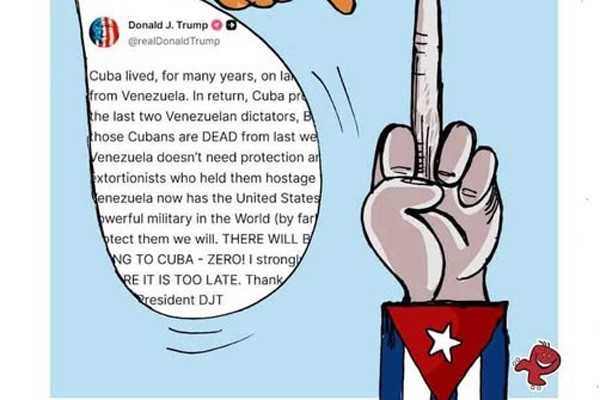
Therefore, it is not surprising that after the kind of ultimatum issued this past Sunday—in which, in addition to ordering not a drop of oil to Cuba, we must “negotiate,” or else we will face the consequences, from the new emperor of the galaxy—many compatriots on social media explained— for those who have eyes to see—on what basis was formed, even institutionally and constitutionally, this congenital rejection by the Creoles and other kindred peoples that ended up defining, or forming, what is Cuban: not to allow ourselves to be humiliated under blackmail or in exceptional circumstances, despite the precious nobility recognized in us and witnessed by the world.
Such significance is attached to the rejection of submission to pressures that it was given legal form in articles 12 and 17 of the Constitution of the Republic, overwhelmingly approved in 2019.
Article 12 establishes, as a principle, that the Republic of Cuba repudiates and considers illegal and null all treaties, concessions, or pacts agreed upon under conditions of inequality or that ignore or diminish its sovereignty and territorial integrity, which implies that any agreement considered imposed under coercion or that undermines sovereignty is declared invalid.
In article 16, which can be considered a support for the first and even an emphasis, it is reaffirmed that economic, diplomatic, and political relations with any other State can never be negotiated under aggression, threat, or coercion.
It is therefore not difficult to understand that in this country, entering into negotiations under force in international relations is absolutely prohibited. This seems very clear to many admirers of the Cuban people around the world who have even, like former Mexican President Manuel López Obrador, praised Cuba as deserving a global prize for dignity.
It is less understandable to the representatives of a brazen fascist right, still lacking consistent brakes for their renewed fascist speculations and adventures concerning the theory of living space, who, after invading Venezuela, kidnapping its constitutional president Nicolás Maduro Moros and his wife and deputy Cilia Flores, and holding them as prisoners of war in New York, believe they can continue their misdeeds without major consequences.
It's not that the Constitution consecrates it; rather, it draws from the history of struggle of the Cuban revolutionaries who, with their actions and honor paid in blood, prepared this people for resistance, never for surrender.
If one delves into our turbulent course, one will not find among the upright patriots any willingness to surrender or negotiate freedom and independence under external force or internal calamities. That is why this very Constitution establishes armed defense and resistance as both a right and a duty and prioritizes, so fundamentally, the defense of sovereignty over any negotiation.
The Pact of Zanjón remains a shameful mark in our history, washed away by its sublime and honorable antithesis: the Protest of Baraguá, led by the Titan who, and this is no minor point, had not only strength in his arm but also in his mind to wield the dignifying machete.
Therefore, it is not surprising that circulating right now on the tangled social networks is a circular signed by José Martí and Máximo Gómez from the General Headquarters of the patriotic forces, stating that the war for the independence of a useful people and for the dignity of the wronged men is a sacred war, and the creation of the free people conquered through it is a universal service. Thus, anyone who attempts to deceitfully stop the war of independence commits a crime.
By virtue of this, it specifies, the Revolution, through its elected representatives—valid until it grants itself new powers—fulfilling its duty, urges you that in the event that any proposals of surrender, cessation of hostilities, or agreements are presented to you by any means and from anyone that do not include the recognition of the absolute independence of Cuba—whose offensive and null proposals can only be a war trick to isolate or disturb the Revolution—you must summarily punish this offense with the penalty assigned to traitors of the Fatherland.
Long before this Mambí circular circulated, the biological genetic chains of patriotism incompatible with surrender were already forming.
The dignified death of the cacique Hatuey, refusing to accept the reward of ascending to heaven promised by the conquistadors who came to Cuba with sword and cross, was among the first sediments. Also, the gesture of Casiguaya, the cacique’s wife who starred in Cuba’s first ten-year independence struggle.
Captured after the rebel’s death, his wife, condemned to the gallows, preferred, before hanging herself, to drown her own daughter rather than leave her in the hands of the cruel colonizers.
The native Naborí would immortalize his grave act in memorable verses:
Before the heinous crime, they allowed him to hold his little girl,
whose face showed a Guama fighting.
The mother held her tight until love killed her,
and she cried out, beautiful in horror:
"Neither Guamá, nor his wife, nor his little girl...
will be slaves of the invader."
Donald, the aspiring new emperor of the galaxy, is quite right;
meanwhile, he sizes us up—and it's not about clothes—
amid so many blusterous boasts, it's worth thinking twice,
because he will have to face a brave, strong people.
Perhaps he understood this better that night when Maduro and Cilia were kidnapped in Fuerte Tiuna,
and he enjoyed it, basely, as one of his spectacles.
That night was not as easy as propaganda portrays,
and that slips out amid his conqueror's tantrums.
This, illustrious emperor, could be another "corojo."
(Taken from Juventud Rebelde)