On November 30, 1964, Ernesto "Che" Guevara gave a speech in Santiago de Cuba, warning that "imperialism cannot be trusted, not even a little bit, nothing." This admonition may be useful in evaluating Donald Trump's proposal for an immediate truce in Gaza and a subsequent, somewhat enigmatic Road Map aimed at achieving future Palestinian sovereignty.
The florid tycoon's initiative, publicized a week ago, was boastfully heralded as "one of the greatest days in the history of civilization." His arrogant and megalomaniacal background makes it hard to believe he would now become the guarantor of a truce. He is calling for a ceasefire at the same time he is changing the name of his Defense Secretariat to the Ministry of War.
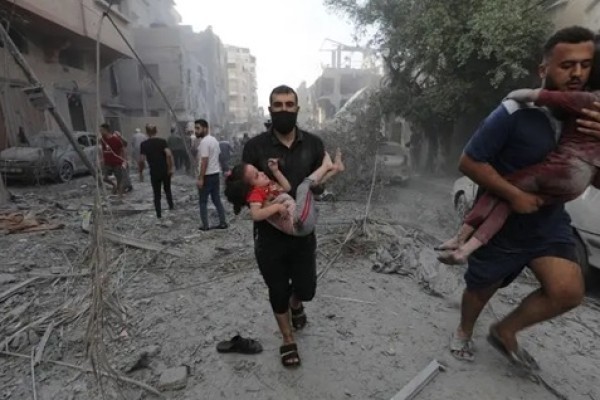
Faced with the dilemma posed by Trumpism, it seems essential to consider the victims' perspective. Even leaving aside—and without ignoring—the logical doubts that arise from any proposal coming from the most prominent proponents of all wars: when two million people have suffered constant bombing for two years, and almost seventy thousand have been murdered, the political and ethical obligation is to consult the victims of these crimes.
When bombs continue to demolish homes everywhere, and crimes against humanity are repeated without the international community having been able to intervene effectively, the only ones who have the right to demand and petition are those who suffer the deaths of their children, the mutilations of their relatives, and the despair of their mothers. When there is a possibility that the bloodletting can be interrupted, postponed, or halted, the voice of those who suffer is the one that must be heard.
On September 30, one day after the White House released its peace plan, the Palestinian National Authority (PNA), headed by Mahmoud Abbas, released a document endorsing the proposal, joining the Arab League, Turkey, and Indonesia.
The PA statement underscores the need to “end the war on Gaza (…) ensure the immediate distribution of humanitarian aid, secure the release of hostages and prisoners, promote mechanisms to protect the Palestinian people, reaffirm respect for the ceasefire, reaffirm Palestinian and Israeli security, prevent the annexation of lands, halt the displacement of Palestinians, and end unilateral actions that violate international law.”
The structural causes that have fueled the conflict, which has lasted more than eight decades, have no definitive timeline for its implementation. This uncertainty is further compounded when linked to the threats issued by the pacifist president, who warned that "hell will break out" if the proposal is not accepted. And it is even more precarious when linked to the global war threats disseminated last week at Trump's meeting with the Pentagon's highest-ranking officials, in which he demanded that the military "prepare for war" and commit to building armed forces that are "stronger, tougher, faster, more ferocious, and more powerful than ever."
Peace, in Trump's words, has curious meanings. A week ago, at the United Nations General Assembly, he presented himself as the figurehead of global harmony by taking responsibility for resolving seven armed conflicts.
The American tycoon's credibility as a peacemaker is only credible to those who dissociate his diplomatic proposals from the countless conflicts and threats he deployed during his first term and which continue today: multiplication of tariff wars; recognition of multilateral organizations; bombings of the Islamic Republic of Iran; threats of invasion of Panama; reinforcement of the blockade against Cuba; siege of Chavista Venezuela; political interference in Brazil; financial blackmail and protection of Javier Milei's narco-government; incorporation of the National Security Doctrine within the United States; persecution of immigrants; various coercions to guarantee the sale of weapons (from the Military-Industrial Complex) to the European Union; and brutal expansion of the hybrid war against the People's Republic of China.
The credibility of his proposal raises doubts, even given the timing of its presentation. The good intentions espoused by the US president coincided, remarkably, with the final stage of the Sumud Global Flotilla's journey.
Thanks to Trump's public proposal, the West's major propaganda factories managed to obscure the newsworthiness of the maritime solidarity effort, which ended up being intercepted by Israeli military forces last Wednesday.
Furthermore, the peace plan lacks specifics regarding the timeline following the ceasefire. However, despite the uncertainty surrounding its outcome—and the varying interpretations regarding the completion of the proposed stages—Gazatis, under pressure that has lasted for up to seven hundred days, are demanding acceptance of the proposal. They demand the return of the hostages by Hamas and are banking on the implementation of the stipulated steps that would guarantee an end to the daily bombings and the urgent arrival of humanitarian aid.
This plea is joined by the clamor of millions of protesters around the world demanding an end to the massacre, and even a segment of Israeli civil society, which assumes its responsibility for the crimes committed against the Palestinian population.
The Israeli newspaper Haaretz recently published an article by two eminent Israeli academics, Daniel Blatman and Amos Goldberg. The essay was titled "There Is No Auschwitz in Gaza, but What's Happening in Gaza Is Genocide."
Blatman is the Director of the Institute for Contemporary Jewish Studies at the Hebrew University of Jerusalem, and Goldberg is a research fellow at the institute. The final paragraph of the article states that "Once the war is over, we Israelis will have to look in the mirror, in which we will see not only the reflection of a society that failed to protect its citizens from Hamas's murderous onslaught and neglected its kidnapped sons and daughters, but also committed this act in Gaza, this genocide that will stain history from now on and forever."
We will have to face reality and understand the depth of the horror we have inflicted. What is happening in Gaza is not the Holocaust. There is no Auschwitz or Treblinka there. However, it is a crime of the same kind: a crime of genocide." The lucidity and precision of this statement is eluded and/or denied by those who continue to justify the massacre of Palestinian civilians in Gaza. Among them, Javier Milei and the DAIA.
(Cubadebate: Taken from Page 12)