The National Series ended with the title of the best postseason team. They finished second in the regular season, but it could also be said that they were the most outstanding. For a long time, they led the standings, earned their direct spot in the Elite League, and did so with a significantly different lineup.
Their version of the playoffs, with the addition of Yurisbel Gracial, Ariel Martínez, and Yoennis Yera, plus Andrys Pérez fully present in every game, became a powerhouse.
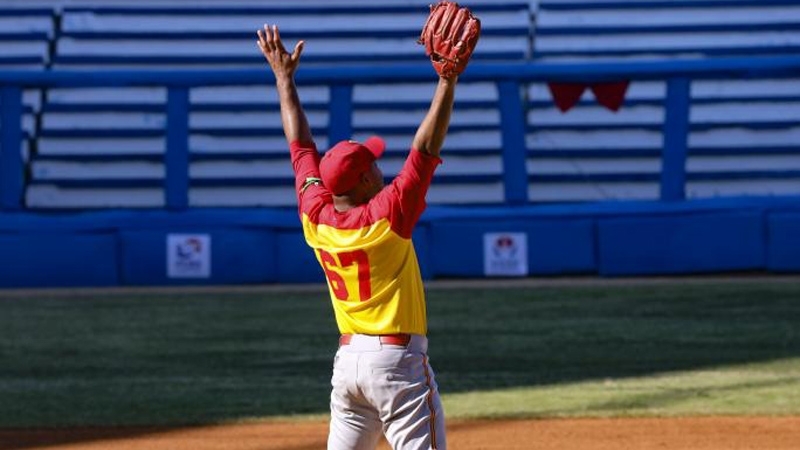
No roster on paper was capable of matching them. The Crocodiles swept through, by merit, by roster, and by a winning mindset that lived in the dogao and expressed itself more strongly on the field.
Opinions about pitches and strikes are as diverse as they are endless. But in the playoffs, the vast majority agreed on the label of favorite for the Reds.
They swept the final not because it was played at a neutral venue, and much less because they faced a lesser team—although Las Tunas was indeed significantly weakened from one series to another.
They swept because their superiority allowed them to rely on contributions from their starters as well as a well-oiled bench, having completed the previous 75 games.
There were no surprises, as this is not the first 4-0 in a final. We don’t have to go far back; in Series 63, Industriales lost 4-0 as well, the last two games in front of their home crowd. Against whom? The Leñadores of Las Tunas.
Not far back in time are also the two 4-0 sweeps by the Azules themselves over Villa Clara, and even more recently, but in the Elite League, the big win by Ciego de Ávila over the Tuneros.
Matanzas is a deserved champion, even though, paraphrasing García Márquez, they executed the chronicle of a foretold victory.
What the season leaves us with are more tasks than results. We will focus on the most important: how to contribute greater quality?
We must study and research the phenomenon of sports development and spectacle, an equation that directly influences the level of play.
Seeing it this way could strengthen the weak side of the National Series: its organizational problems, from its competitive structure to its assurance design; aspects that are directly proportional.
One cannot think about quality with 16 teams, for a simple reason: the structure would be bigger than its support.
But, given the country’s complex situation, we had baseball, the playoffs were guaranteed, and that is a grand slam with the bases loaded for the Cuban baseball authorities, demanded by a passionate fandom to turn seasons around and keep baseball calling the hearts of its people.