


Nuevitas, Camagüey, July 22.- "Facing head-on" everything that looks like "technological madness" seems to be the maxim that makes the difference between producing energy at the 10 de Octubre Thermoelectric Plant —located in this city in northern Camagüey— or halting its manufacturing process.
It is no small feat to keep the "Battle Horse of the National Electric System (SEN)" working—as this industrial colossus is also known—since the harsh years of the Special Period in the 1990s.
Staying in the relentless fight, amidst the economic, commercial, and financial blockade imposed by the empire, entails an immense commitment to the history of dedication shown by the workers to their thermoelectric plant. In this place, from generation to generation, local expertise is promoted as a pillar to reshape rudimentary and rusted iron, working a miracle of functional and original innovations.
The Inventor Friends
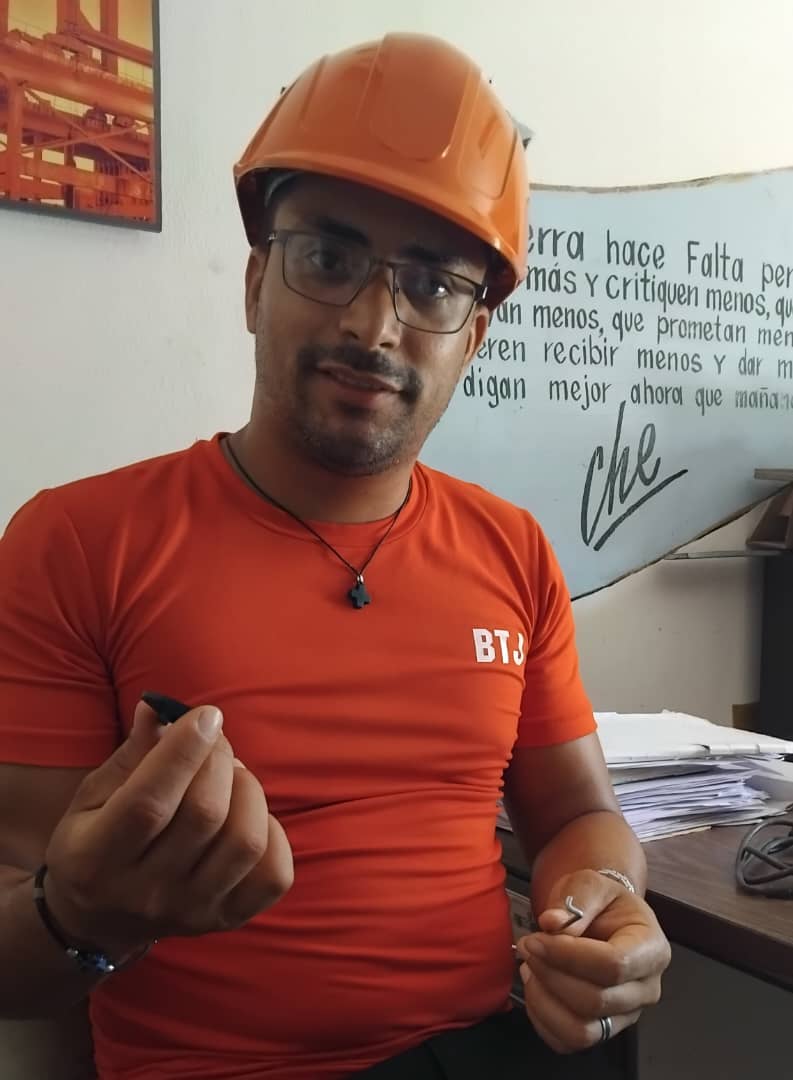
A pair of friends, Eneas González Ondarza, an industrial engineer, and Andrés Manuel Hernández Torres, an electrical engineer—bonded since childhood in their neighborhood—built very similar projects and careers in their cherished hometown of Nuevitas, a land of legendary, smoking chimneys.
Growing up on the picturesque coast of Agramonte, these friends, now 30 years old and with over 12 years of uninterrupted service at their old factory, present timely on-site creations. These innovations confirm that youthful talent grows with every challenge faced by the "electricians" of this coastal city.
Eneas, who also serves as the Head of the Automatic Workshops Brigade, recounts that one of the most challenging tasks they shared was manufacturing an oil flow sensor for the oil centrifuge (Alfa Laval), designed for the intermittent discharge of solids while separating two mixed, mutually insoluble liquid phases of different densities.
"The constant incidence of oil flow mixed with waste substances and water caused a rupture in the bimetal that activates the sensor's mechanism," the young engineer explained. "It was a necessary job that could not be postponed," or else Unit Six of the thermoelectric plant would come to a halt.
With a similar sense of responsibility, his colleague Andrés added: "The sensor failed due to the deterioration accumulated over years of overexploitation. Without it, the centrifuge—a vital element for the operation of Block Six—could not be started.
"There was much at stake, Eneas recalls. He explained that the oil centrifuge (Alfa Laval) separates water from oil during the continuous lubrication process throughout the various operating stages of the turbine.He added that when the oil centrifuge failed due to the broken oil flow sensor, it was taken out of service, "which triggered the total shutdown of Unit Six."
"This part was impossible to replace because the factory did not have it in its warehouses," Andrés assured, while Eneas added: "That technological shortage required us to manufacture it in the shortest time possible," which demanded extra responsibility, technological research, and even sleepless nights, "because sleep was driven away," they recalled with a smile.
They had no choice but to cling to the idea that "it was indeed possible to build the oil flow sensor," they recounted.
However, the solution they found turned out to be one of the most genuine, authentic, and bold contributions of this prestigious institution from Camagüey. Never before had the old proverb "the pitcher goes to the spring..." found such concrete realization. After experimenting with multiple materials, both young men certified that the treated bronze alloy, no longer in use at the plant, "was the ideal metal to solve this problem," Andrés stated.
Eneas noted that, despite more than 30 years of uninterrupted use, the bronze alloy showed no wear or damage, which certified its hardness and elasticity to withstand the cumbersome continuous work it would undergo moving forward.
The constant search for alternatives by this duo of innovators achieved what seemed unattainable: fixing the breakdown and ensuring that, to this day, Unit Six continues to run at full power.
The two researchers have plenty of reasons to be happy because, in addition to the economic impact of the invention—exceeding 750,000,000 pesos—other effects catapult it as a strategic contribution: the operation of the centrifuge's oil pump and the ordinary, uninterrupted use of the equipment were restored, the viscosity parameters and characteristics of the oil used in the turbine's work cycles were improved, and the degradation of its sensors was prevented.
The Fair of Inventions
In another original proposal, Andrés managed to manufacture a conditioning cam for the loading of six-kilovolt (kV) switches, which are essential for the efficient operation of the generation blocks.
"Without the proper functioning of these devices, a notable loss or limitation in the energy production of the units occurs," expressed Andrés, who, along with his team—composed of Eneas González García (father), Osvaldo Navas Torres, and Rosbert Barroso Columbié—did not hesitate to launch this novel innovation in response to the breakdowns of the 6 kV busbar.
He asserted that to ensure the unit maintained its work cycles, it was necessary to construct the conditioning cam, as there were no manufacturers offering this possibility, nor could the institution purchase it due to its high cost.
"We managed to replace its flimsy plastic, which had little mechanical endurance, with aluminum—a metal that, in addition to being resistant and ductile, allows for the protection of the stem where the cam is coupled. This ingenious idea, verified in practice, allowed four of these devices to be put back into service at the plant," he revealed.
Eneas is not far behind. Alongside his father, he adapted an iron spring, but made with a special alloy, which allows it to resist the aggressiveness of caustic soda and ferric chloride.
Eneas insisted that the greatest impact of this innovation, beyond the economic savings, lay in the fact that it returned five of these pieces of equipment to the production process—fundamental for the production of demineralized water—as well as improving the quality, safety, and reliability of the operation.
He reaffirmed that this approach can be generalized in the osmosis plants installed in the country that use these pumps, and that its impact is also valued because the institution does not have to import these devices.
In the workshop of both young men, other similar stories will be born, alongside an industry that strives to adopt them as its own, because they are part of its tangible heritage and legacy of resilience, as they are born precisely from the drive and talent of its hundreds of men and women with a pure passion for their legendary chimneys.
(Taken from Radio Nuevitas)


