

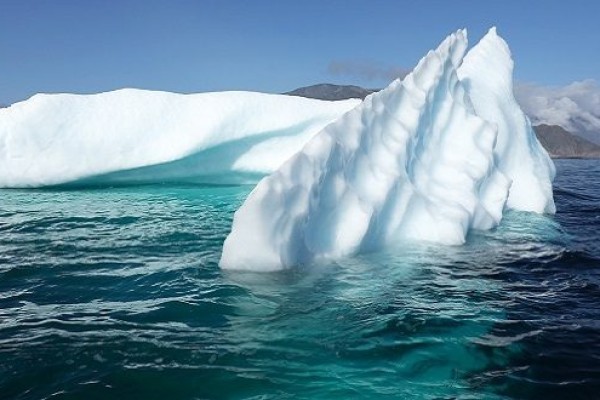
A scientific investigation has succeeded in measuring the speed at which ice masses are vanishing worldwide, projecting a concerning outlook, according to the periodical publication Nature Climate Change.
Considering different warming thresholds, the number of ice bodies that could vanish each year might range between two thousand and four thousand, a phenomenon directly linked to the increase in Earth's temperature.
The analysis, conducted by experts from the Swiss Federal Institute of Technology Zurich, the Swiss Federal Institute for Forest, Snow and Landscape Research, and the Free University of Brussels, indicated that the Alps could reach their critical peak of most intense disappearance between the years 2033 and 2041.
On the other hand, the global peak of glacier shrinkage would occur approximately ten years later.
If global warming of 2.7 °C is reached, calculations predict that by 2100 only 110 glaciers will remain in Central Europe, which is equivalent to just 3% of the existing alpine total today. An increase of 4.0 °C would reduce that number to approximately 20.
The team recorded more than one thousand disappearances of these formations in Switzerland between 1973 and 2016.
Areas with a large number of small glaciers located at low altitude or tropical latitudes — such as the Alps, the Caucasus, the Rocky Mountains, the Andes, and the African massifs — are particularly threatened.
In these places, it is anticipated that more than 50% of the glaciers will be lost within the next 10 to 20 years, explained Van Tricht, specialist at the Chair of Glaciology at the Swiss Federal Institute of Technology Zurich and the Swiss Federal Institute for Forest, Snow and Landscape Research.
The researchers developed detailed projections for various mountain ranges. For the Alps, a 1.5 °C warming scenario would leave about 430 of the approximately three thousand current glaciers by the end of the century (12%), while a 2.0 °C increase would preserve around 8% (about 270).
As a reference, the Rocky Mountains could retain 4,400 glaciers with a warming of 1.5 °C, representing 25% of the current 18,000.
The Andes and Central Asia would lose more than 90% of their glaciers, respectively, in the scenario of the highest greenhouse gas emissions.
Globally, with a temperature increase of 4.0 °C, only about 18,000 glaciers would remain, compared to nearly 100,000 that exist today.
The researchers proposed a new term, “glacier extinction peak,” to define the year in which the greatest number of annual disappearances would occur.
With a rise of 1.5 °C, this peak is estimated to be reached in 2041, with close to two thousand losses in a single year. Under a warming of 4.0 °C, the figure could reach four thousand glaciers lost in 2055.
These results are expected to assist populations, public policy makers, and natural risk managers in planning for a future with reduced access to ice reserves and derived water resources.
(Taken from Cubadebate)

_large_large.jpg)