Marco Rubio has unleashed an aggressive campaign of falsehoods and bullying to secure votes against Cuba at the United Nations General Assembly. One week ahead of the annual vote on the blockade against Cuba, the Secretary of State has launched a diplomatic offensive to try to shift the landscape: not so much to gather "no" votes as to transform affirmative votes into abstentions or absences.
A cable from the State Department, leaked to Reuters and dated October 2, reveals the strategy: linking the resolution on the blockade with the war in Ukraine and presenting Cuba as a threat to regional peace.
The document, distributed to dozens of embassies, instructs U.S. diplomats to pressure governments to oppose the resolution, based on the accusation that between one thousand and five thousand Cubans would be fighting alongside Russian forces. "After North Korea, Cuba would be the largest contributor of foreign fighters," states the text.
The objective is explicit: significantly reduce affirmative votes at the UN; "no" votes are "preferred," but abstentions or non-participation also count. In statements to the press this Wednesday in Havana, Cuban Foreign Minister Bruno Rodríguez Parrilla displayed a facsimile of the State Department document and claimed that Cuban-American congress members have sent additional letters threatening to condition their votes on other aspects of the bilateral relationship. Unmistakable gestures from neighborhood bullies.
The offensive comes amid a context of tightened sanctions following Trump's return to the White House, which does not tolerate that last year the resolution was approved with 187 votes in favor, with the United States and Israel opposing and Moldova abstaining. This precedent highlights the countercurrent nature of the ongoing maneuver.
Havana's response has been categorical: Cuba is not part of the armed conflict in Ukraine nor does it participate with military personnel "there or in any other country." The Ministry of Foreign Affairs publicly detailed criminal actions related to mercenarism concerning that front: nine cases (2023-2025) against 40 accused; eight trials and five convictions totaling 26 individuals, with sentences ranging from five to 14 years; three cases pending judgment and another in process. The foreign ministry maintains a policy of "zero tolerance" against mercenarism, trafficking, and nationals' participation in conflicts abroad.
Meanwhile, the Caribbean is being militarized under the pretext of the "war on drugs." Washington is extrajudicially killing crew members aboard vessels, reinforcing its naval presence, and testing engagement rules that escalate the intensity of force used. The campaign of blackmail against governments to undermine the Cuban resolution is not a separate chapter but rather a narrative cover for this escalation, which opportunistically coincides with a diplomatic operation to divert attention from the deep suffering caused by the blockade on the Cuban people.
Confirmed as Secretary of State in January, Marco Rubio has placed Cuba at the center of his hemispheric agenda. Among his measures is the repeated use of visa restrictions against foreign officials whom he accuses of participating in the alleged "coercive labor export scheme" of Cuban medical missions. Rubio has made every possible effort to criminalize one of the island's most recognized cooperation programs.
The Secretary of State has also amplified controversial narratives from the past—such as hypotheses about external causes of the so-called "Havana syndrome"—that the U.S. intelligence community considers "very unlikely" following interagency assessments from 2023 and 2025. The contrast between that evidence and political rhetoric illustrates the method: loading the media climate with fallacious national security claims to weaken support for the resolution.
But historical arithmetic is stubborn. Since 1992, the General Assembly has overwhelmingly approved the call to lift the embargo, and in 2024, the result was 187-2-1. With that precedent, it is likely that the resolution will be approved again with a very large majority, even if Washington manages to muster some abstentions or absences.
If history is any guide, the assembly's overwhelming pronouncement will be repeated.
(Originally published in La Jornada, Mexico)
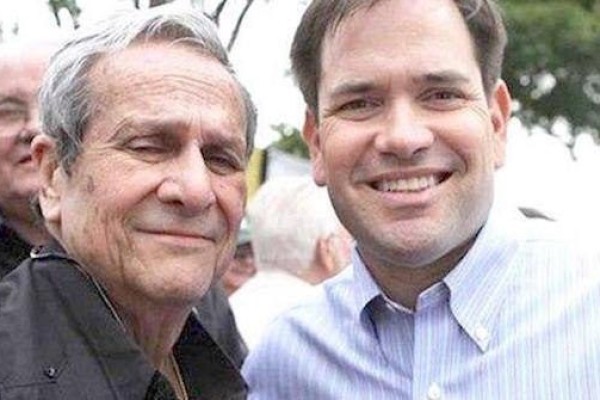
Pictured: Marco Rubio (right) and Félix Rodríguez, the assassin who claims responsibility for Che's death at La Higuera.
Photo: X Taken from Cubadebate