It's not a literary device to write that imperial gunboats are targeting Venezuela. That's what's actually happening with the unprecedented US military deployment, with missile-armed warships, combat aircraft and helicopters, drones, a nuclear submarine, and thousands of soldiers massed in the Caribbean Sea.
To demonstrate his brutal military might, Donald Trump ordered the destruction of three boats he claimed were transporting drugs to the United States. On September 2, the first attack resulted in the deaths of 11 people; on September 15, four more were killed. There is no further information about the third attack, except for Trump's statement: "We actually shot down three boats, not two, but you saw two."
These attacks were carried out in undeclared war zones, against civilians who posed no threat and who were not subject to any form of judicial process. Long after the attacks, on October 2, 2025, Trump sent a memorandum to Congress declaring that the United States was engaged in a "non-international armed conflict with drug cartels." These executions constitute war crimes, violate international law, and almost certainly U.S. laws.
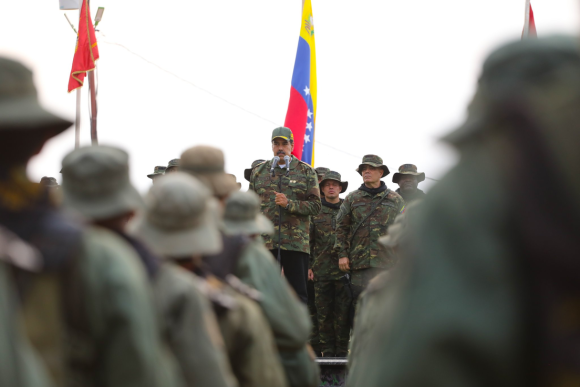
Recently, NBC reported that the United States is preparing options for military strikes inside Venezuela. At the same time, in the event of such attacks, the government of President Nicolás Maduro has been preparing for a military and citizen deployment in defense of its sovereignty. On September 29, he signed a decree declaring a state of external shock, which would be activated immediately in the event of an attack.
Rhetorical Arsenal
Since the George Bush Jr. administration, every US administration has deployed its full arsenal of rhetoric against the South American country. The countless fallacies range from the well-known defense of democracy, accusations of terrorism, and links to the guerrillas of the Colombian Armed Forces (FARC) and the National Liberation Army (ELN), to Barack Obama's famous declaration that Venezuela represents an "unusual and extraordinary threat" to the internal security of the greatest military power humanity has ever known.
During Trump's first term, the same cards were used, adding "humanitarian aid" as a Trojan horse to initiate a series of military actions on the border with Colombia. During Joseph Biden's presidency, in addition to the "defense of democracy" card, drug trafficking was added. In his second term, Trump intensified his attacks, reinforcing all his previous ones with an emphasis on the supposed fight against drug trafficking, his racist platform of war on migrants, and his campaign to reduce China's presence in the region.
By all means
During the 26 years of the Bolivarian Revolution, the United States and the Venezuelan oligarchy organized, financed, and executed a series of plans to overthrow the governments of Hugo Chávez and Nicolás Maduro: multiple coup attempts, sabotage of the oil industry and electricity supply, and assassination attempts. They also used mercenaries to organize armed incursions within Venezuelan territory. They fomented divisions within the Armed Forces to provoke military uprisings.
The hundreds of unilateral coercive measures, which should really be called extortion measures, caused damage from which very few countries could recover. Before their implementation, Venezuela had oil revenues of more than $56 billion; their effect reduced that income to $700 million, a little over 1 percent. The economic, trade, and financial war aimed to break the economy and, consequently, the structures of social and political cohesion. Furthermore, they even used the pandemic as a weapon to achieve their ends.
Imperial failures
Since the time of Hugo Chávez, all these efforts have failed. From the North, they thought that, after his death, the civic-military unity would break down. They didn't count on the fact that Nicolás Maduro would not only maintain the continuity of the revolutionary process, but would also resist the unspeakable attacks from Washington, that he would not be isolated in his international relations, that he would manage to diversify and grow the economy, that he would overcome the various stigmatization campaigns, and that he would strengthen the unity of the Venezuelan people.
It's the oil, my friend.
According to the book "The Threat," by former acting FBI Director Andrew McCabe, during a July 2017 meeting, President Trump asked, "Why aren't we at war with Venezuela? They have all that oil, and they're right at our back door."
Later, in 2023, after he was out of office, Trump told a crowd: “Venezuela, we’re buying oil from Venezuela. When I left office, Venezuela was on the verge of collapse. We would have taken it over, we would have kept all that oil.”
There is no doubt that seizing Venezuelan oil is an obsession for every US administration. However, it is not the only one. Venezuela is one of the richest countries in the world, has abundant renewable and non-renewable natural resources, and its geographical location is strategic.
The United States and its allies violently seized Iraqi oil in 2003. The crimes of extermination committed against the Iraqi people have resulted in the tragedy of more than a million deaths.
In Libya, the invasion took place in 2011; after more than 120,000 deaths, the country remains mired in chaos. It has two central banks to manage two oil exploitation hubs, ensuring affordable prices for European markets.
In Syria, in 2024, with the support of the US, France, and the United Kingdom, Al-Qaeda leader Al-Sharaa seized power after a war that claimed the lives of more than half a million people. It is worth noting that before the fall of the Syrian government, many oil wells fell into the hands of those who sponsored Al-Shara's rise. These oil wells were the first target of the imperial offensive against that country.
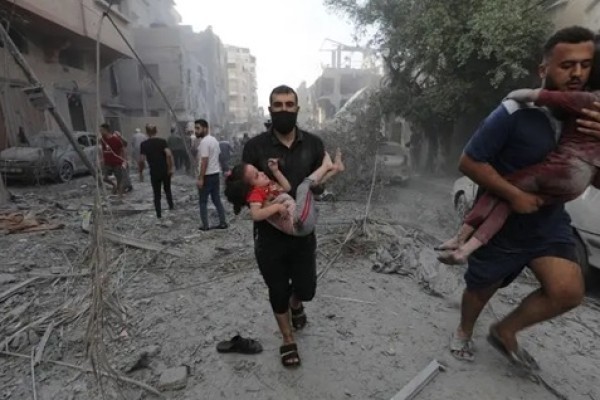
Now, in the midst of the genocide against the Palestinian people, in which they are also complicit, the decadent and declining empire is turning its guns on the Venezuelan coast. The consequences of an imposed war would be grave for the entire region. One need only recall what happened to the countries of West Asia and the Sahel after the imperial crimes in Iraq, Libya, and Syria.
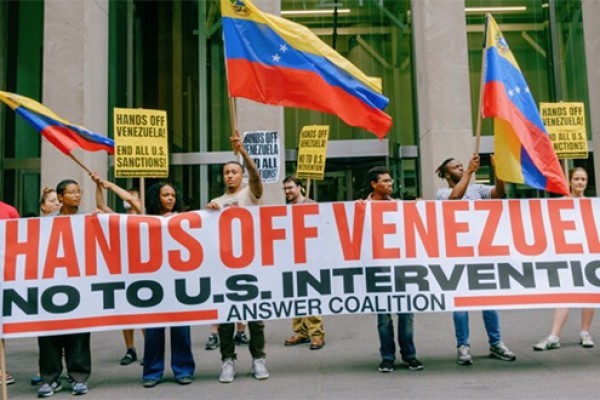
Based on the lessons history teaches us, defending Venezuela is a duty. For those who believe in the principles of the United Nations Charter, defending Venezuela is a duty. For those who defend international law, defending Venezuela is a duty. For those who defend the CELAC Proclamation, which declares Latin America and the Caribbean a zone of peace, defending Venezuela is a duty. For those who believe in the sovereign equality of states, defending Venezuela is a duty. For those who believe in the self-determination of peoples, defending Venezuela is a duty.
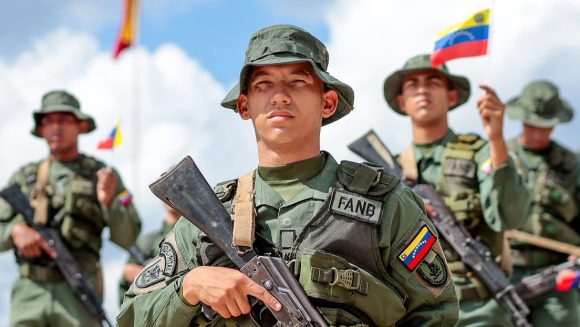
Taken from Cubadebate