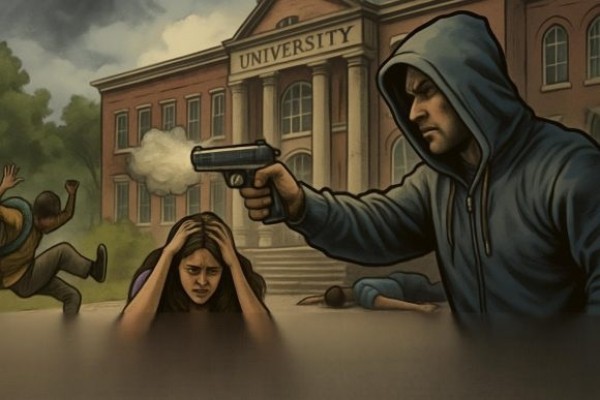
The murder of Charlie Kirk at Utah Valley University (UVU) last September brought the issue of university insecurity in the United States back into the world spotlight.
Kirk, a staunch defender of gun ownership, was a victim of the very violence toward others that he preached.
But this isn't the only case of violence or unrest at American higher education institutions. Last April, at Florida State University in Tallahassee, the state capital, a shooting left at least two dead and several injured.
Organizations such as the National Rifle Association and Students for Concealed Carry suggest that allowing staff, faculty, and students to carry weapons on campus could reduce the incidence of campus crime. Most university administrators, including many in states with gun laws like Texas, argue that this could have precisely the opposite effect. Colorado, Idaho, Kansas, Mississippi, Oregon, Texas, Utah, and Wisconsin allow concealed firearms on college campuses.
Insecurity breeds fear. Anything can cause chaos on university campuses. Utah State University experienced a stressful time in late September after one of its buildings was ordered evacuated due to the presence of a suspicious package.
A Utah State University (USU) building was evacuated on September 30, 2025, after a suspicious device was detected near the Old Main building just before a Turning Point USA (TPUSA) event, the first since the murder of its founder, Charlie Kirk, in Utah weeks earlier.
University police and the bomb squad immediately responded to the alert and cordoned off the area. As a precautionary measure, the device was detonated in a controlled manner, and authorities later confirmed that it did not pose a real threat.
According to official university reports and local media outlets such as KSL News and The Salt Lake Tribune, the device turned out to be a telemetry collar used for wildlife research, possibly left there by mistake during an academic practice.
More than 50 universities in the United States have been affected by a wave of false threats of gun violence since early September 2025.
According to AP News and reports confirmed by the Federal Bureau of Investigation (FBI), campuses in Louisiana, Alabama, Virginia, and Georgia were forced to react to calls, emails, or messages anticipating nonexistent crises, particularly on September 11 and 12. The FBI is investigating the coordination of these acts, which, according to law enforcement agencies, defy both emergency response systems and student safety procedures.
These incidents, known as "swatting," have led to temporary campus closures, the suspension of classes, and the deployment of police resources, amid heightened social sensitivity over recent shootings on academic campuses and the standardized violence in American society.
Adding to the unsafe environment is the report that approximately 26% of college women are raped or sexually assaulted in the U.S., according to data collected by the Association of American Universities (AAU), and only 20% of them go to the police, according to the Department of Justice.
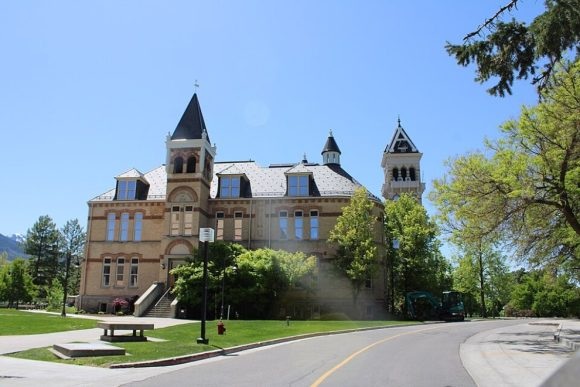
Utah State University's Old Main Building. Wikimedia Commons / Chris Light
Guns are not the worst enemy
Being a college student in the United States these days isn't exactly a good deal. This summer, Mr. Trump canceled the student debt forgiveness imposed by the previous administration, which, according to the Education Data Initiative, now stands at $1.693 trillion. Some 42.7 million students owe federal student loans, with a per capita balance (including private debt) of $41,618.
According to U.S. News & World Report, the average cost of tuition and fees among the top-ranked private universities in the U.S. has increased by about 41 percent since 2005. Between 1978 and 1979, attending a private university cost $17,680 a year and a public university $8,250. Today, these costs average $48,510 and $21,370, respectively, making access to a college education nearly impossible for millions of families and helping to perpetuate inequalities and resentment toward higher education. The problem is compounded by declining public funding.
Trump's brutal crackdown on universities, based on alleged anti-Semitic acts on higher education campuses or on their status as "hotbeds of liberalism," has unleashed multi-billion-dollar cuts to American higher education.
Motivated by a desire to punish his enemies, dismantle the progressive intellectual elite he believes dominates campuses, and build a new one that reflects conservative cultural values, Trump has launched an unprecedented offensive against dozens of universities that he claims are violating federal laws and regulations by using racial preferences in their admissions processes, promoting antisemitism, and failing to protect Jews on campus or women in athletics.
The attacks have ranged from canceling federal contracts with universities, freezing billions in research dollars, blocking the admission of foreign students and detaining dozens of them, or requesting data from these students.
Some universities, like Harvard, have half-heartedly stood up to the Trump administration. Others, like Columbia, have completely bowed to the emperor's demands.
“Columbia’s capitulation has turned a university that was once a place of free inquiry and learning into a shadow of its former self, an ‘anti-university,’ a place of fear and loathing, where faculty and students are told from above what they can say and teach, or face severe sanctions. Unfortunately, all of this is being done to cover up one of the greatest crimes of this century, the ongoing genocide in Gaza, a crime in which Columbia’s leadership is now fully complicit,” wrote Rashid Khalidi, professor emeritus at Columbia University and one of the leading Palestinian public intellectuals in the United States, in an article after announcing the cancellation of his fall term at the university.

Students on the Columbia University campus on April 14, 2025, in New York City. Photo: AFP
Little confidence in universities
The stifling anti-university atmosphere fostered by Trump has exacerbated a latent decline in American confidence in higher education. A Gallup poll shows that a growing proportion of American adults report having little or no confidence in higher education.
When Gallup first measured confidence in higher education in 2015, 57% had a lot or quite a lot of confidence, and 10% had little or no confidence. Now, 32% have some confidence, 32% have little or no confidence, and only 36% have a lot or quite a lot. No other institution has experienced such a steep decline in confidence between 2015 and 2023.
In addition to the deeply divisive ideological controversies fostered around universities, among the causes of this weariness is the rising cost of higher education, which has reached unsustainable levels.
Furthermore, there is growing skepticism about the value of a college degree. According to a Pell survey, only 22% of American adults say a college degree is worth the cost today, and four in 10 adults say a four-year college degree is not very important or not at all important for landing a well-paying job. A recent study by the St. Louis Federal Reserve Bank shows that the college earnings premium (the additional income earned by a household headed by a college degree, compared to a similar household headed by one without a college degree) remains positive but has declined for recent graduates, and that college and graduate education may be failing some recent graduates as a financial investment.
And this skepticism is justified: most students don’t graduate from their colleges (according to the National Center for Education Statistics, in 2020, the overall six-year graduation rate for undergraduates in the fall of 2014 was 64%), more than half of graduates end up underemployed (according to a report by the Strada Institute for the Future of Work and the Burning Glass Institute, 52% of four-year college graduates are underemployed one year after graduation), and, as we’ve seen, most students graduate with increasing levels of debt.
In times of obscurantism in the United States, the meccas of knowledge are frowned upon by those in power, nor by society as a whole. They, with all their history and resources, are today a reflection of imperial decline and the supremacy of capital over knowledge.
Taken from Cubadebate.