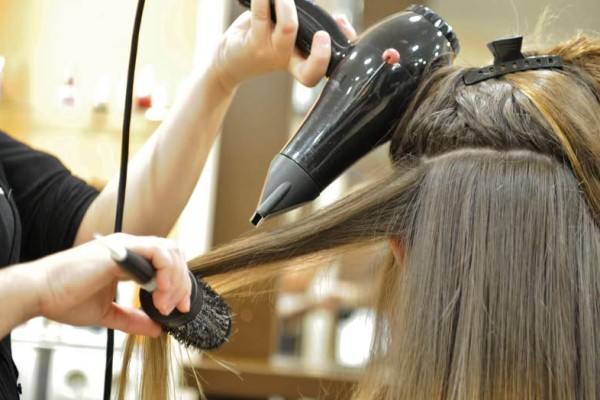
December. In the last days of December, there is a ritual that repeats itself in the neighborhoods of Cuba: going to the hairdresser. It is not just about looking for a haircut or a dye; it is about finding a mirror that reflects, even if just for a moment, the image of oneself renewed. The hairdresser turns into a meeting point where, amidst strands falling and laughter shared, Cuban women comb their hopes and untangle the knots of an intense year.
While I wait in line, I observe. Here, you don’t just book a haircut appointment; you put your life in line. Each client carries woven within her a story of 2025. I think that this simple act of beauty is, at its core, a symbolic act of great power: in every healed tip there is a wish for 2026, and in every centimeter of hair that falls to the floor, an obstacle we decide to leave behind.
Small matriarchies form a queue.
For example, the grandmother, gray-haired and free, has just combed through her first year of retirement. While flipping through a magazine, she says she misses the hustle and bustle of her office. With a mixture of dignity and disappointment, she mentions that retirees were not invited to the union’s year-end event. “Production wasn’t met, anyway,” she says, then returns to the fashion pages with a gesture that hides everything.
Her big, wild consolation is by her side: her granddaughter, who this year crossed the threshold from primary school into the complex land of middle school. The almost-teen resists the chair: “Don’t cut it too short! It needs to grow for my 15th birthday.” Three years away, but she already sees herself that way, and that alone is a victory of this school year: becoming a “young lady.”
The atmosphere of the line is supportive. “Go ahead, you’re in a hurry,” I say to the young woman who arrives out of breath. She looks a lot like me. She left her mother taking care of the baby born in August. “If I bring him, I can’t even sit down,” she confesses with a tired smile. Her urgency is not just vanity; it’s the longing to reconnect, beneath the layer of new motherhood, with the woman she has always been. She deserves it. She has been brave.
In the chair, the teacher. “Cut it, cut it without fear,” she orders, and her voice in the mirror sounds like a challenge. She talks happily about the event for Educator’s Day and, with a shade of resigned sadness, about colleagues who alternate classrooms with other trades: manicurists, bakers, artisans. “They are champions,” she whispers. The hairdresser, focused on cutting, replies with the wisdom of a fellow worker: “That’s why I’m going to make you look phenomenal. It’s not easy to face a classroom for a whole year.”
“Just like us,” comments softly the nurse, waiting her turn. Under the cap she still wears as an invisible uniform, a thick, dark mane appears. Cutting it seems like mutilation, but she seeks a change, a style that celebrates the fully realized woman she is. She knows her hospital may not have the perfect closed system, but she hopes for 2026 with faith in a new cycle, and wants to welcome it with the perfect layered cut. Her patients might not notice immediately, but she will feel it.
I look around and silently review the catalog of lives that this salon hosts today. Not all are here, but those essential to the story: the one who graduated against all odds, the one who sealed a love or dissolved another, the one recovering from an accident, the one serving a social sentence and seeking to rebuild herself, the one mourning a loved one, the one announcing new life, and the one who said goodbye to a piece of her heart at an airport.
The hairdresser shakes out the cape. A whole year of dust, worries, small and great achievements falls to the floor. It has been an important, difficult, intense year. For each woman in this room, for every Cuban woman, for Cuba itself. And that deep, collective truth is felt in December. It is felt even here, in the simple and powerful ritual of renewing one’s hair while strengthening the spirit, strand by strand, hope by hope.
(Taken from Juventud Rebelde)