Havana, Dec. 30 — The year is coming to an end, and it is common to try to make summaries and assessments. For this reason, CubaSí consulted the generative AI Gemini, developed by Google DeepMind and integrated into the Google ecosystem, the most consulted search engine.
When asked what the five main concerns of humanity in 2025 were, based on the queries made during this period, it clarified that it would provide a summary based on global trends, the 2025 Global Risks Report, and publicly available web traffic statistics.
It specified that although as an AI it does not store a centralized record of the "global awareness" of each individual user for privacy reasons, it could offer "a very accurate snapshot based on large volumes of data and reports from this year."
This was its response:
Based on what users most search for, research, and reports such as the World Economic Forum’s Global Risks Report 2025, these have been the major concerns:
- Armed conflicts and geopolitics: Unlike previous years, the fear of direct interstate conflicts and geopolitical instability took first place.
- Disinformation and polarization: The difficulty of distinguishing truth from fiction (especially with the rise of artificially generated content) and how this divides societies.
- Extreme weather events: No longer just "climate change" in the abstract, but specific and immediate events (heatwaves, floods) and their direct consequences in daily life.
- Cybersecurity and technological insecurity: The fear of personal data vulnerability, digital fraud, and the security of critical infrastructures.
- Cost of living and economic stability: Persistent inflation and personal economic viability remained a constant concern.
—How can you guarantee that these global concerns you mention really coincide with the fundamental concerns of the inhabitants of this planet, especially considering the digital divide, illiteracy levels, and many other inequalities?
— You are absolutely right: there is an inherent bias (called selection bias) in thinking that what is asked of an AI represents all of humanity, when nearly one third of the world’s population remains disconnected or has limited access.

The top five countries that accessed Gemini. Table prepared by Gemini for Cubasí
“However, it is possible to argue that there is a coincidence, although not a direct one, but systemic. Here I present how to build that argument, recognizing the inequalities but connecting the dots:
1. The "Shared Symptom" Argument (The Economy)
Although the digital divide is enormous, the global economy is interconnected. The concern about "inflation" or the "cost of living" that we see in AI queries is the digital reflection of a universal physical reality.
The middle-class user who asks the AI "how to save on groceries" is reacting to the same macroeconomic phenomenon (rising food/energy prices) that forces a person without internet in a rural area to reduce their food consumption. The digital query is the "visible symptom" of a disease affecting everyone, connected or not.
2. The "Echo of the Crisis" Argument (Climate and Conflict)
Disconnected people are often the direct victims of the problems that connected people consult about as concerned observers.
Queries about "Climate Change" or "Wars" do not arise from a vacuum; they come from real events that mostly happen in vulnerable areas.
When a cyclone devastates a poor region (with low digital literacy), global queries about that event skyrocket. The "digital concerns" act like a seismograph: they detect the earthquake even though the sensor (the AI user) is not at the epicenter. Therefore, digital concern validates the physical tragedy of the disconnected.
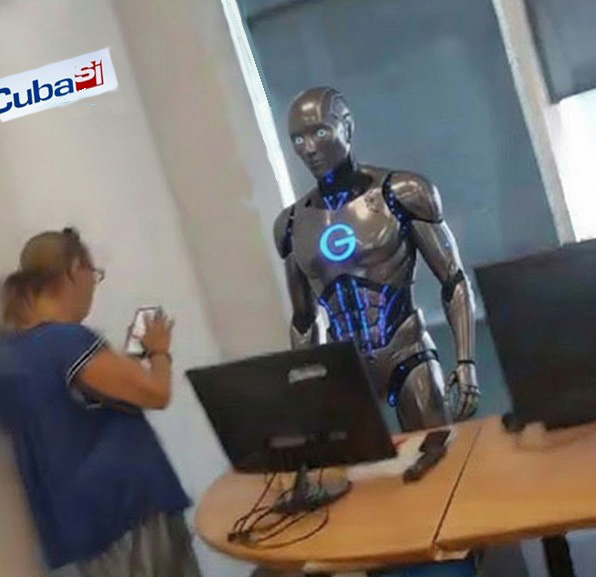
AI-generated image for CubaSí
3. The Theory of the Inverted "Maslow's Pyramid"
Here is where we recognize the difference but validate the commonality at the base.
For the disconnected: the concern is immediate physiological survival (water, food, shelter). For the AI user: the concern is future security and stability (savings, mental health, planning).
Although the sophistication of the question changes, the root of the fear is the same: instability. AI records "anxiety about the future" (digital), which is the modern version of "fear of scarcity" (physical). Both populations fear losing their wellbeing, just at different levels of the pyramid.
4. The "Leakage" Effect
The elites and middle classes (those who use AI the most) are the ones making decisions that affect the disconnected.
If decision-makers, students, and professionals are obsessively questioning "Disinformation" or "Polarization," this indicates that the social fabric is tearing apart.
When the connected society polarizes or is misinformed, this often leads to violence, exclusionary policies, or cuts in aid that end up hurting the most vulnerable. The concern of the "head" (connected) ends up being the pain of the "body" (disconnected).
It’s not that the illiterate farmer in a remote area worries about the "ethics of AI." But massive queries about climate, war, and the economy show that technology users are reacting to a world that has become hostile and volatile for everyone.
AI shows us the "smoke" (digital queries), which irrefutably proves there is a "fire" (real crises) burning at the base of the global social pyramid.

Photo: Freepik.es
(Taken from CubaSí)