There are dates that cannot be overlooked, and May 11th is one of them, because in Camagüey—and in all of Cuba—no one forgets the day when 'El Mayor,' at just 31 years old, became immortal.
And this is not mere rhetoric. It is that there are men who die only in body, but their spirit remains loose along the paths, and as years and centuries pass, they end up mounting a horse once again.
We see it today, from this year 2026, and it seems incredible to us: a twenty-six-year-old lawyer, newly married, son of a wealthy family, who leaves everything behind to enter a war that no one thought could be won. Anyone would say he was mad. But no. He possessed the clarity of someone who knew how to read his time. He knew that Cuba needed him, and there he was, to face the empire of his era.
It was not just about wielding a machete. Agramonte was a lawyer, a thinker, a framer of constitutions. He drafted the first Constitution of the Republic in Arms. He defended the abolition of slavery with the same strength with which he charged against the Spanish columns. And all the while, he wrote letters to Amalia. Letters that still touch our souls: 'Only for you, always for you.' Affectionate, yes. The kind that does not turn commitment into oblivion, but into the deepest reason for struggle.
The people of Camagüey know this better than anyone. That is why, when someone says they are agramontino, they are not just talking about a simple demonym. To be agramontino involves a way of acting that believes in honesty, in study, and in courage without pretense. It means recognizing a man who, at 31, had already participated in more than a hundred battles—one hundred, no less—and had performed extraordinary services to the cause of independence.
And here, in the present, that image is not a museum relic. It is more of a mirror. How many young people today, facing the enormous difficulties of the blockade and daily wear and tear, resemble that model? They are the ones holding the country together. Those who study, those who create, those who mount a horse in the face of adversity, or sit before a computer with that same spirit of service.
Because Agramonte does not ask us to take up a rifle. He asks us not to be indifferent to injustice. That we fight today's battles with intelligence and with the same sense of 'vergüenza'—shame/honor—that he did; yes, with that shame, the exact word he used when someone asked him what they could rely on to continue the struggle.
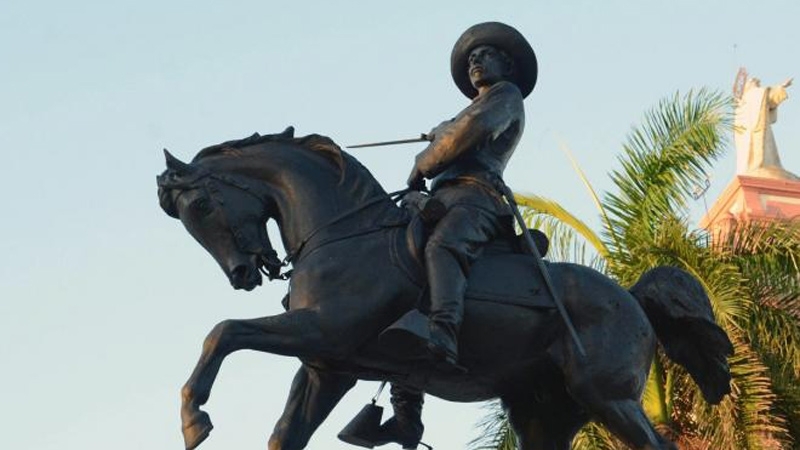
That is how we see him, on this anniversary: he is the boy who defied death. The proof lies in his park, in Camagüey. There the rider remains, sword raised and gaze fixed. He is not a statue. He is the lookout of the present.
The people of Camagüey pass by and look up. They know that there, in that equestrian figure, rides the paradigm—the youth who knew his homeland needed him and did not hesitate. Because he is not a museum pride: he is memory turned into future. As long as there is a young person with their honor held high and a heart that is both strong and tender, continuing to push a country forward, 'El Mayor' has not fallen. He continues to ride across his plain, across his island.