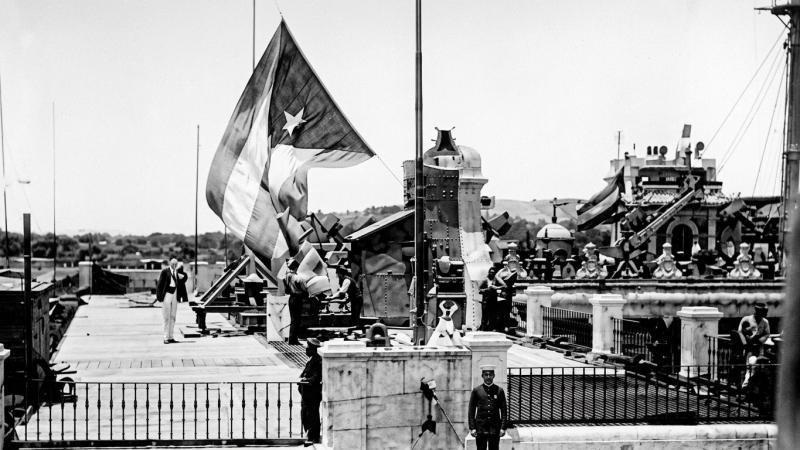
On May 20, 1902, the U.S. intervention authorities handed power in Havana to the first Cuban president, Don Tomás Estrada Palma. In cities and towns across the country, the proclamation of the Republic was celebrated after 30 years of struggle for independence.
Thousands of people gathered along Havana Bay and in front of the Palace of the Captains General to witness the lowering of the American flag and the raising of the Lone Star flag at that building and El Morro. Meanwhile, balloons bearing Cuban flags rose into the sky, and wooden triumphal arches featuring patriotic motifs or themes of friendship with the presumably disinterested northern neighbor—which had made the country's independence possible—were erected throughout the island.
At the same time, the first photographic studies reproduced images of beautiful, well-groomed young women with the Cuban flag alongside a U.S. soldier gallantly guarding it, while the mainstream press of the era covered the event without sparing words of gratitude for the United States' intervention.
This was the prevailing popular ideology that concealed the true interests of the emerging imperialism, which could only succeed after the deaths in combat of José Martí and Antonio Maceo—the primary leaders who, with a clear anti-imperialist consciousness, could have guaranteed Cuban unity to prevent annexationist designs.
Patriots who warned of the true objectives of these false allies were scarce, objectives described with great sincerity by one of the main actors in that plot, U.S. Governor Leonardo Wood:
“Of course, Cuba has been left with little or no independence with the Platt Amendment, and the only thing indicated now is annexation (...) It is quite evident that it is absolutely in our hands (...) With control, which will undoubtedly soon become possession, we will shortly and practically control the world sugar trade (...) The Island will gradually become Americanized, and in due time, we will have one of the richest and most desirable possessions in the world.”
The enthusiastic Wood had plenty of reasons for the establishment of the first neocolonial system in the world, which had been foreseen by the founders of the U.S. as ripe fruit that would fall into their hands after breaking away from the Spanish colonial empire.
Although they waited patiently until 1898, when Cubans in their third war of independence were forecasting Spain's certain defeat in a short amount of time.
The timely and mysterious explosion of the battleship Maine in Havana Bay, at the beginning of 1898, provided the final impulse for the intervention of U.S. troops, who required the support of the mambises for the landing of Marines and operations on the eastern coasts.
To this end, the Americans approached local military leaders such as Calixto García, which, in addition to facilitating their military operations, sowed potential discord among the independence ranks, as there was initially no recognition of the supreme command of the Liberating Army or the organs of the Republic in Arms.
After the brave and decisive help provided by the Cubans for the triumph of the campaign, they prevented the Liberating Army and General Calixto García himself from entering Santiago de Cuba to participate in the Spanish surrender in 1898, under the pretext of possible Cuban vengeance against the Spaniards; this prompted a dignified response from the Cuban leader in a letter addressed to General William Shafter, in which he vigorously protested the affront.
The prominent mambí leader wrote to the American military officer: “(…) we are not a savage people who disregard the principles of civilized warfare; we form a poor and ragged army, as poor and ragged as the army of your ancestors was in their noble war for the independence of the United States of America; but, like the heroes of Saratoga and Yorktown, we respect our cause too much to stain it with barbarism and cowardice.”
In Tomás Estrada Palma, U.S. politicians found a servile collaborator. The future Cuban president had settled in the U.S., where he dedicated himself to education, and from his initial patriotic positions during the Ten Years' War, he moved toward the conviction that his compatriots were incapable of governing themselves without the tutelage of the great power, and foresaw that annexation could be a solution for their future.
These tendencies were not widely known, and he eventually replaced José Martí at the head of the Cuban Revolutionary Party, which he dissolved after the war ended, closed its newspaper Patria, and became an important factor in the demobilization of the Liberating Army and the leadership organs of the Revolution, among other services rendered to imperial purposes.
The U.S. administration also forced the Constituent Assembly, responsible for drafting the fundamental law of the Republic, to include in its articles the (Orville) Platt Amendment. Drafted by a senator of the same name, this amendment established the right of his country to intervene militamente in the island, prohibited the nation from establishing international treaties, created conditions to cede Isle of Pines to the Union, and required the surrender of bays for coaling stations, among other conditions detrimental to national dignity.
Thus, the new republic was born, which the world considered a protectorate of the United States, possessing the appearance of an independent territory by having a flag, an anthem, and a presumably independent government.
It was not until January 1, 1959, that the definitive dismantling of more than 50 years of imperialist domination—promoted on that distant May 20, 1902—began.