

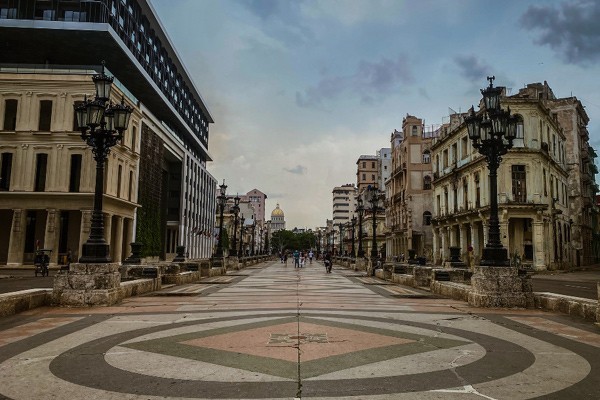
When was Havana truly founded? Tradition insists that under a ceiba tree that stood at the site where El Templete would be erected, the first mass and the first council meeting took place, marking the founding of the town on November 16, 1519.
If we adhere to that date, the city would now be celebrating its 506th birthday, but history seems to be older, and its origins are lost in deep obscurity. Some historians give July 25, 1515 as the date of its founding, while others, and it seems more accurate, speak of July 25, 1514.
The town was originally established on the southern coast, in an unspecified location that would lie between the west of Surgidero de Batabanó and the Bay of Cortés. This primitive settlement, named San Cristóbal, was the sixth population founded by the Spaniards, not the seventh, as had long been believed. Only when it was established on the northern coast, on land belonging to the aboriginal chief Habaguanex, did it begin to be called, perhaps to differentiate it from the other, San Cristóbal de La Habana.
The date of this relocation is also unknown because it seems that at one point both Havanas coexisted; the transfer of the population from south to north was not an organized move but a gradual flow of inhabitants. Once in the north, the initial location of the city was linked to the Casiguaguas or Chorrera River, now known as Almendares. However, the people of Havana gave up the convenience of obtaining water and sought a new settlement on an islet that projected into the bay like a peninsula. Previously, they had settled at the bottom of the port, near the Luyanó River, where there had been an aboriginal village, and they moved to their definitive settlement between 1538 and 1540 when, by order of Hernando de Soto, the first castle, known as Fuerza Vieja, was built.
The Best and Most Brilliant Expedition
It was precisely with De Soto that Spain began the practice of granting governance of the Island to figures who were not residents. Thanks to his significant influence in the Court, he managed to be appointed Governor of Cuba for a period of five years and also Adelantado of Florida. This latter position was what truly interested him, as he believed he would find in that territory—then named not only for the peninsula but for a vast area of southern North America—the same fabulous riches found in Mexico and Peru. His venture was a failure, and De Soto met his death (1542) during the expedition. "The best and most brilliant expedition that until then had been seen in the New World" left the Island exhausted and depopulated, as the Adelantado took with him 1,000 armed men, 350 horses, eight ships, a caravel, and two brigs, along with all the supplies of cassava, corn, bacon, and salted meat he encountered along the way. In 1544, when news of De Soto's death reached Havana, only 1,749 people remained in six of the seven towns established at the beginning of colonization, of which only 112 were Spanish. In the colonial policy of the metropolis, Cuba was overshadowed by the viceroyalty of New Spain; however, as Eduardo Torres Cuevas writes, soon the Crown realized its growing strategic importance.
A new navigation route began to consolidate. Instead of traveling against the Caribbean Current—from Yucatán to Santiago de Cuba and Hispaniola—only to then venture into the Atlantic, it was more natural to come to Havana and from this city, propelled by the Gulf Stream, reach the western coasts of Europe. An active trade developed between America and Spain, with Cuba situated in the middle of the itinerary, making the port of Havana fundamentally important for the defense of the Spanish Empire, a fact that Madrid's enemies also became aware of. Due to the wars between Spain and France, the first privateers appeared in the Caribbean Sea: in 1536, a French ship captured three Spanish vessels at the gates of Havana, and its crew later raided the town, which lacked defenses. Two years later, another privateer reduced it to ashes, but in 1542, the residents, entrenched in La Fuerza, repelled the French privateer Robert de Baal, who had already plundered the Colombian cities of Santa Marta and Cartagena. The people of Havana could not prevent Jacques de Sores from seizing the city and destroying it in 1555.
The Fleets
Between 1537 and 1541, the system of Fleets and Armadas was organized for the protection of trade with the Indies, and Havana emerged as a meeting point for the convoys. However, it was from 1550 onwards that the number of ships visiting the port of Havana began to grow: a document from 1572 acknowledged that it had become a major port frequented by vessels and fleets coming from New Spain (Mexico), Tierra Firme (South America), and Honduras, serving as a key entry point to the Bahamas Channel and a supply station for forces in Florida. Parallel to the trade along official routes, a smuggling route emerged, bringing life to other marginalized areas of the island excluded from legal commerce.
Spain wanted to consolidate the population of the island; it needed to. As early as 1520, it issued a royal decree threatening death and confiscation of property for anyone who abandoned the island territory. However, the colonial government violated its own laws and promoted, as in the case of Hernando de Soto, the recruitment of men for expeditions heading to the continent. In 1544, Juanes de Dávila seriously attempted to stop depopulation and economic decline by asking each wealthy resident for two thousand gold pesos to promote the sugarcane derivative industry, but the active classes opposed this contribution. His successor, Antonio de Chávez, persisted in Dávila's efforts and decided to establish his residence in Havana. Gonzalo Pérez de Angulo also settled there to replace him and continued his attempts to boost the sugarcane derivative industry while advocating for copper extraction and taking measures to abolish Indian servitude. In 1556, a new governor, Diego de Mazariegos, established the seat of colonial government in Havana as mandated by the Crown. Five years later, the system of the Flota de Indias was officially established. The town became the capital and would thereafter be one of the most coveted prizes for privateers and pirates, which determined its fortification—a process that would extend over three centuries and transform it into a stronghold of American trade routes.
Market, Den, Brothel
Twenty years after its definitive settlement by the port of Carenas, Havana was nothing more than a poor hamlet stretching along the bay's shoreline, along Tacón Street, from the barren land at the back of what is now the Castillo de la Fuerza to the space occupied by the Lonja del Comercio. It then extended along the streets of Oficios and Mercaderes, due to their proximity to the unloading site of ships. The Real or Muralla Street was the exit to the countryside, and to the north, a road—essentially a promenade—led to the San Lázaro cove, from where the possible arrival of enemy vessels was monitored. The city also expanded southward toward the cove of Guanabacoa.
The first inhabitants of Havana circumvented the strict commercial monopoly established by the Peninsula through smuggling. This forced them into illegality, transgression, and disrespect for the law, influenced significantly by the fact that their port was the meeting point for the fleet. During the second half of the 16th century, despite being labeled as “the stopover for all the Indies,” Havana was a small town with a sparse population and pronounced poverty; its inhabitants primarily lived off renting their houses and selling provisions to crew members and passengers of ships docked in port, vessels that typically ranged from 19 to 30 in number. This sometimes prolonged invasion of crew members and passengers, people of various nationalities and relaxed habits, turned Havana into a savory and lucrative market for debauchery, as noted by one historian who added: “The capital, market, den, brothel, devoured gold and unleashed concupiscence…”
The city progressed. On Real, Sumidero (O’Reilly), Rede (Inquisidor), and Basurero (Teniente Rey) streets, houses were built in a line; they were made of straw and cedar and had fruit trees planted. No one went out alone at night; stray dogs and feral animals roamed freely, and the plague of mosquitoes was irresistible. The wealthiest slept in imperial beds imported from the Peninsula and brought ebony and granadillo furniture; they were illuminated by oil lamps that arrived from Seville and fueled with olive oil. There were dances and entertainments. Tableware consisted of Sevillian ceramics, although there were also glasses and plates made of guayacán. Cassava was eaten in the absence of something better; turtle meat and tasajo were favored, corn was prepared in many ways, and the main dish was ajiaco, a mix of fresh and salted meats cooked together in pieces, seasoned with chili and colored with bija. The inhabitants of Havana consumed every year—according to the Capitular Acts—300 cattle, “some” pigs, 52 barrels of wine weighing 18 arrobas each, 50 quintals of soap…
What Went In and Out
Historian Alicia García Santana believes that the economic growth of the capital was also possible because it could appropriate the productive potential of the territory that lay between the towns of Sancti Spíritus and Trinidad in the center of the island and in the westernmost part. From there came the timber that was exported to Spain and that which was used in the Havana shipyard. Cuba had a strong shipbuilding industry until the early 19th century; it is recorded that between 1724 and 1813, Havana's shipyards launched 49 ships, 22 frigates, 7 packet boats, 9 brigs, schooners, and 4 pontoons, among other vessels. Moreover, between 1787 and 1806, the Havana arsenal enriched the Spanish Navy with 29 warships. Alongside this industry, other artisanal manifestations developed that not only covered domestic consumption but also satisfied the needs of travelers and the foreign market. Notable sectors included livestock, tobacco, and of course, sugar.
Everything That Went In and Out
Everything that entered and exited Cuba did so through the port of Havana. In 1717, the Tobacco Monopoly was established, and in 1739, the Royal Company of Commerce of Havana was created, which enriched Havana producers and merchants at the expense of those from the rest of the country.
The situation changed radically in 1762 with the capture of Havana by the British. The occupiers abolished the Spanish trade monopoly and opened sugar, tobacco, timber, and other products to European markets, while Cuba was opened to English production. In 1763, the British left Havana, and nothing was the same again. Spain had no choice but to remove the economic barriers that hindered the growth of the colony. In 1778, free trade was approved with the Spanish ports designated for that purpose.
Compact and Monumental
From then on, Havana continued its course alongside its bay. The political importance of Cuba, said Alexander von Humboldt, does not lie in its territorial extent or in the admirable fertility of its soil, but in the advantages offered by the geographical position of Havana. Emilio Roig points out that it is through Havana that Cuba has generally been known in the world. For almost the entire colonial period, the history of Cuba is the history of Havana. The British only need to take Havana and do not concern themselves with the rest of the Island; Bolívar never refers to the independence of Cuba but rather to the independence of Havana…
A city that grew considerably in population and area, acquiring the compact and monumental character that defines it, whose historical and architectural values and system of fortifications made it a UNESCO World Heritage Site.
Owner of time and memory is this Havana, bustling and talkative, so well captured in the canvases of René Portocarrero. Maritime, open, and unprejudiced, yet also shy and sober, as if hidden. A crossroads of peoples, a privileged enclave.
_large_large.jpg)