Camagüey. — In the San Juan de Dios 11A gallery, the day passes with an almost monastic calm. Outside, the hot stone; inside, the cool shade and the song of the sparrows. The workshops face each other, and after lunch, the artists cross the street for a brief gathering before the clock strikes one. Joel Jover collects punctually; Magdiel approaches when the work eases; Eduardo Rosales and Pepe come and go. There is no tension: there is camaraderie.
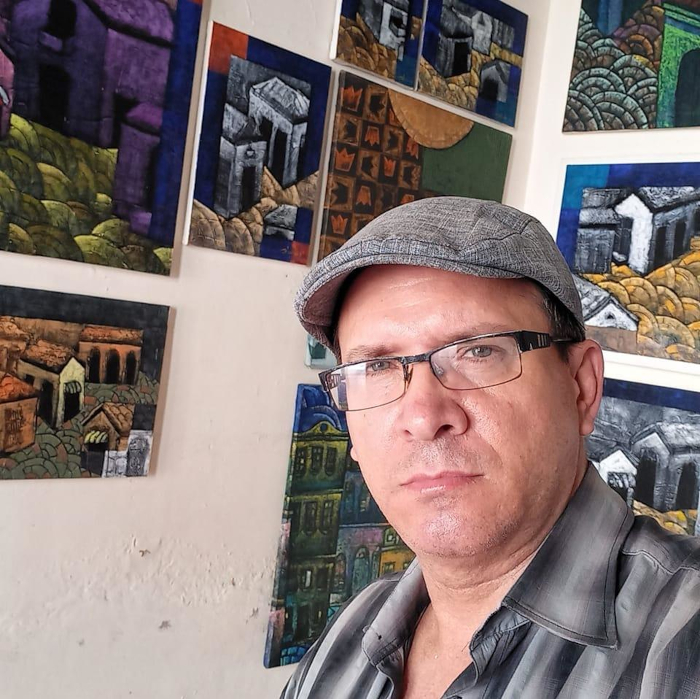
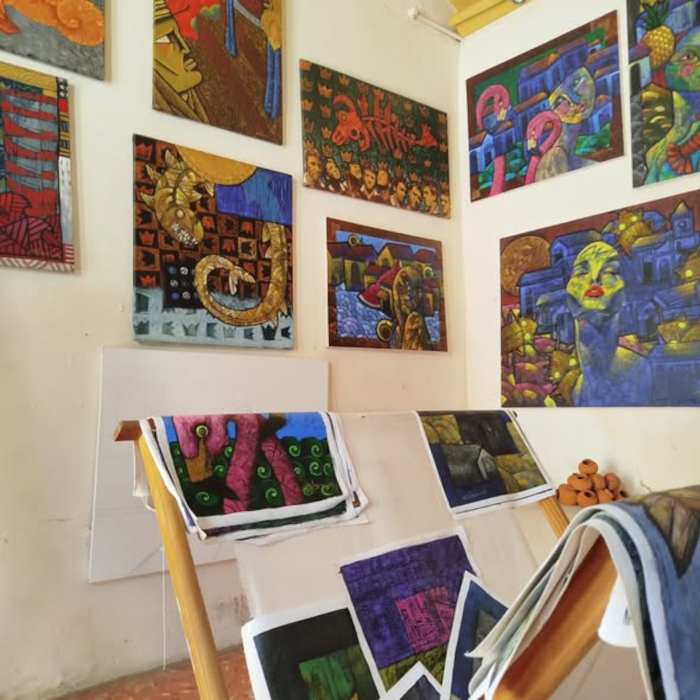
In that environment works Celso Lázaro de Zayas Vázquez. He paints, steps back, approaches again. The city that appears on his canvases is neither bright nor postcard-like: it is a dark, textured silhouette, almost like clay.
"I'm very bad with dates," he says, smiling. "I don't know how many years I've been doing this."
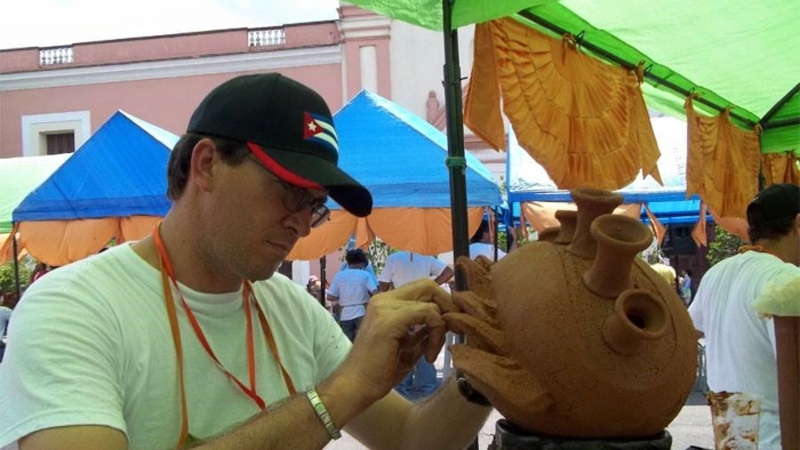
But he remembers that at five years old he modeled a ceramic piece that won a prize in Lenin Park. He grew up in Florida, among plaster, wax, acrylics, and metals, in the dental prosthetics lab where his father worked.
"With the leftovers, I used to make things. You're making me open a trunk I had closed."
Ceramics came first in a rustic way: digging a hole in the yard to get clay. Later came the influence of Oscar Lasseria and those murals of feathered birds that dazzled him. In Florida, together with other creators, he was part of a small group of ceramicists who worked and shared ideas in a town where few imagined that movement.
He always drew. He always painted. And when ceramics couldn’t be worked on, the canvas became a refuge. From that period came one of his most remembered figures: the “tilapia de potrero,” a mythological being with a fish’s spine and a cow’s head.
— I spent a long time on that series. I filled it with symbols.
Before that, the guajiro (peasant) had appeared, peeking from the corner of the canvas, repeated over and over, a witness to everyday contradictions.
— The same face always. We were all taught that everything here was very good, and the faces never changed.
Eight years ago, he moved to Camagüey. He arrived for family and work reasons. “My other country would have been Havana,” he confesses, but life brought him here. And like any newcomer, he got lost in the city’s capricious layout.
— If you try to take a shortcut, you get lost.
From that wandering came his first exhibition at the Office of the Historian of the City of Camagüey: Traveler’s Postcards. They weren’t the usual postcards of inner courtyards and large clay jars bathed in sunlight. They were dark cities.
— Since I arrived, there were power outages. I couldn’t paint a brightly lit house.
He remembers a full moon night when he saw the city outlined in silhouette. Without a camera, but with the image engraved in his mind. Since then, he paints without lights, focusing on the drawing, with a texture that reveals his background as a ceramist.
— I will never stray from that.
In his most recent paintings, the city blends with the body. It can be hair, it can be a dress. It can be filled with fireflies or fish. In one of the series currently exhibited at the Bodegón of San Cayetano, the city holds water and fish, as if the sea that once bordered the town flowed back inside.
— Camagüey is the city I invented. No street is exact, but it is the city.
His life has also had chapters away from the easel. In Florida, he directed construction brigades when the Cielo Floridano cabaret was revitalized.
Without knowing anything about construction, he gathered the workers and told them that whoever knew best was in charge of their trade. He dreamed of the municipal gallery on a plan he himself drew and insisted that the roof had to be fixed before putting in the floor. That renewed gallery was born from that drawing that hung in his office.
Later, he took on responsibilities in the Cuban Association of Artisan Artists and the Provincial Council of Plastic Arts. Those were intense years.
— I lost creative time, but I got to know my colleagues thoroughly.
During the pandemic, he arranged aid for vulnerable artists, promoted the purchase of artworks, and pushed for documentaries paid as oral contracts. He tells this without grandiloquence, as part of a natural duty.
In the workshop, between paintings, there is a ritual: the cigar.
— It’s not snobbery. It’s culture.
He learned not to inhale the smoke, to pair the tobacco with drinks, to enjoy the flavors. “For me, the glass will always be half full,” he repeats. The smoke rises slowly, like the patience with which he layers paint.
On the walls of the space, not only hang his works. There are also small paintings of cats and vernacular Black figures by Ileana Sánchez, and two ceramic pieces of his designed to hold incense or lamps. He shares the space, shares the vision.
Now he dreams of a new series: Camagüey is a Woman’s Name. Eight or nine ceramic pieces, and just as many in painting.
— I’m going to make it. I don’t know where, but I’m going to make it.
He speaks like he paints: direct, without unnecessary embellishments. A proud Floridian, a countryman without flowery words, an artist who found a way to name the city in its night. And as evening falls in San Juan de Dios, he bids farewell to the canvas with the Cuban "abur" (see you tomorrow). Outside, the sparrows. Inside, the city in half-light.