Bogotá, April 27 — The violent escalation that has been raging in southwestern Colombia is today convulsing a society already on edge due to the proximity of the presidential elections, which are just 34 days away.
Since last Friday, at least 22 attacks, according to data from the Attorney General's Office, have shocked several municipalities in the departments of Cauca and Valle del Cauca.
The first was an explosive attack recorded in front of the headquarters of the Third Brigade of the National Army at the Pichincha Military Canton, in the south of the city of Cali, which injured three people and damaged vehicles and surrounding infrastructure.
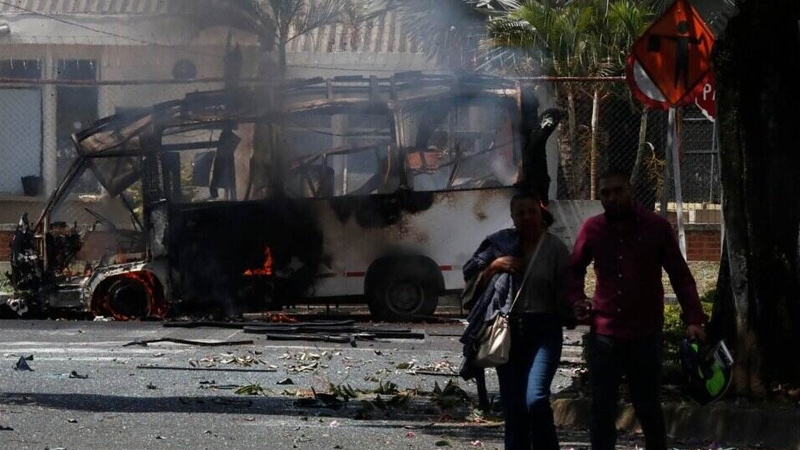
However, of all the violent events recorded in the last two days, the deadliest occurred on Saturday in the municipality of Cajibío, in the department of Cauca, when a device exploded as a bus passed by, causing the death of 20 people and injuries to 36 others, according to Governor Octavio Guzmán.
Military authorities attributed the attack to the self-proclaimed Central General Staff (EMC), a residual group of the former Revolutionary Armed Forces-Army of the People, led by alias "Iván Mordisco." Defense Minister Pedro Sánchez announced an offensive in the region with the arrival of eight additional platoons and two other armored vehicles, as well as the introduction of unmanned aerial systems (drones) to improve surveillance and monitoring of the territory.
The country's president, Gustavo Petro, described the perpetrators of the attack as terrorists, fascists, and drug traffickers.
"I want maximum global pursuit against this narco-terrorist group. I want the UIAF (Financial Information and Analysis Unit) on their finances, I want the best soldiers to confront them, I want the people of Cauca to be freed from this mafia, detritus of violence," he wrote on his X social media account.
Presidential candidate Iván Cepeda, from the progressive Historical Pact movement, also rejected the incident and estimated that the occurrence of these "terrorist" actions in southern regions of the country, "where there is broad citizen support" for the left's political project, was deeply worrying.
"A legitimate concern arises about whether, in addition to causing harm and unrest among the population, these acts seek to generate a climate of fear that favors the interests of far-right sectors determined to destabilize the country and hinder the democratic development of the electoral process. I request the authorities to rigorously clarify this context and possible motivations," the politician wrote.
The Defense Minister estimates that the violent escalation is retaliation for actions carried out against the EMC in the zone, in which case it is Operation Perseo, an offensive launched on October 12, 2024 by the Military Forces to regain control of the township of El Plateado, in Argelia, Cauca.
More recently, other military actions allowed for the detention or neutralization of several of alias Mordisco's closest collaborators, some of whom were his brothers.
In addition to Argelia, in El Tambo, Buenos Aires, Suárez, Jamundí, and Buenaventura, just to name a few municipalities, a large part of the coca crops in the southwest are concentrated.
There are also many of the most important enclaves dedicated to illegal mining in the area.
Although the EMC and the Government initiated peace talks, these were broken two years ago by the president's decision after an attack, attributed to that group, against the indigenous Nasa community in Toribío, Cauca, which caused the death of a leader of that community.
Since then, the war against Mordisco and his subordinate structures has been frontal.
Following the most recent violent escalation, the Defense Minister stated that the fight will now be stronger.
"We will employ the full capacity of the State to neutralize those who persist in attacking the Public Force and the community; our offensive will be sustained," he stated.