For some reason, perhaps out of secondhand embarrassment, the images and notes I followed from an electioneering and Plattista show about five years ago in Florida have not been erased from memory. Donald Trump was the main actor, alongside the shameful stagehands: the Cubans who have supported his obsessive attacks against Cuba from then until now.
Some who are well paid around the world trying—in a ridiculous and submissive English—to win the affection of a president whom, by that time, was no longer spoken well of even by his closest relatives, while they launched all kinds of darts against their country, its leaders, and the Cuban institutional system, with an emperor who looked at them with disdain, truly made one feel pity.
Not even the pioneering patriots, when nationality and political definitions were still blurred in a thick fog of confusion, turned their backs with such shamelessness on emerging Cuban independence.
The feeling that such attitudes leave in anyone who loves Cuba with the same tenderness as José Martí is that the attendees under the dubious celestial roofs of the Doral Jesús Worship Center church were nothing more than the first appetizer of the expensive $580,000-a-couple dinner intended to swallow voters, with which the magnate wanted to remain in possession of the White House to lead the world into the ethical, moral, and civilizational chaos in which it currently finds itself.
The vulgarity and political crudeness of that event came just in time to remind us of the serious dangers of forgetfulness in a nation like ours, and even something more sinful for the national libertarian dreams: that someone, out of selfishness or improper interests, innocence, ignorance, or manipulation, harbors the hope that a country project can be conceived relying on a North American “good neighbor” policy, especially when it comes to someone like the current man who is casting the White House in a Manichean light.
That regrettable scene can be compared to José Martí’s excitement on the evening of Saturday, March 14, 1892, when he held in his hands, stained with fresh ink and warmed by the print that delighted his soul, the first issue of the newspaper Patria.
His faith, and that of the team who accompanied him in the birth of that prodigal child of ideas for the Revolution, was so great that no one retired or rested until the packages were ready for distribution. The Apostle shared the burden of the packages, risking his health, in the cold nights of New York.
When the tabloid was still a distressing aspiration, it would give an ethical lesson that is being violated right now, so many years after that birth, by those who accept strange funding and try to whitewash it with all kinds of justifications to create platforms that only promote “Cuba’s inability for its own redemption,” as the Apostle would emphatically describe them.
“The newspaper would already be published, for Cuba and for our America, which are one in my foresight and my affection, if I could decide to accept help from those who, publicly or secretly, do not fully share my way of thinking,” he would say in a letter to his friend Gonzalo de Quezada.
Those who, more than studying, or by repeating based on selfish interests or empty propaganda, assumed the Martian ideal, have well understood that José Martí believed that freedom of thought and action could only be guaranteed with economic independence. If the Cuban independence cause accepted funds from a foreign government, especially the United States, whose annexationist intentions he so feared, it would become indebted and, therefore, dependent.
For the National Hero, it was necessary to join forces with the oppressed to strengthen the system opposite to the interests and ruling habits of the oppressors. This constitutes an essential foundation of his ethics, which prevented him from accepting help from a power that could become a new oppressor.
It is well known and celebrated that the funding of Patria mainly came from contributions from tobacco workers and other Cuban emigrant workers in Tampa, Key West, and New York. In this, he did not see charity but the conscious contribution of a people toward their own liberation. That way of acting protected the purity of the cause.
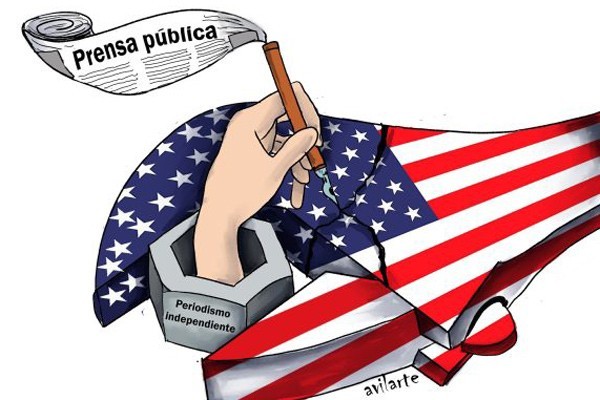
Therefore, one cannot help but feel discomfort when reading or hearing those who claim to practice “independent” journalism and promote private press in Cuba, while proclaiming loudly, with shameful pride, that their funds come from US agencies which, as has been clearly investigated, are nothing more than CIA fronts and other agencies for exercising their global hegemony, to install and remove governments at will.
Not a few of those private media outlets, or their main managers, began by presenting themselves as counterweights to the incapacity or inefficiency of the media system of the Revolution, trying to distance themselves from Yankee regime change projects and refusing to accept that they received foreign funding and other support with that purpose. Some even created platforms to show their followers their cleanliness and transparency in handling funds.
Coming Out of the Political Closet
In recent years, at least two of these platforms have openly and publicly acknowledged, with similar tones, not only their true purposes but also their funding. First, El Estornudo did so, and more recently, the now openly counterrevolutionary El Toque followed, under the pressure and evidence from accusations made from Cuba, alleging that they serve the interests of the economic destabilization of the country promoted by the United States government.
This is what José Jasán Nieves Cárdenas did: “To whom it may concern: I do not hide my political commitment nor play at ambivalence, equidistance, or analytical detachment... I want the end of the ‘dictatorship’ in Cuba... I work to change the existing political regime and bring democracy, justice, and prosperity to my native country...”. For this, he added, “I collaborate with those who share my goals or simply want to work with me in building something useful (of course, not for Castroism, the military, or the Communist Party).”
A first success, among the economic, political, and socially relevant outcomes expected from this revelation, can be noted precisely in this acknowledgment. The pressure of the evidence made them definitively come out of the political closet.
Although it is good to be cautious, because this type of acknowledgment does not always exist, even when working toward the same objectives—sometimes consciously, and other times naively or innocently.
The script of this scenario, as I said in an interview with Temas magazine some time ago, was masterfully described in a text presented at one of our book fairs titled The CIA and the Cultural Cold War, by British journalist Frances Stonor Saunders.
The book exposes the secret campaign in which some of the most enthusiastic defenders of freedom of thought in the West—including George Orwell, Bertrand Russell, Jean-Paul Sartre, and Arthur Schlesinger Jr.—as well as renowned intellectuals from former socialist countries, ended up becoming, consciously or unconsciously, crude instruments of the American intelligence service.
The funds for the “sedition” against communism in Cuba can be openly announced and also arrive through numerous covert channels, not always directly from U.S. pockets and agencies—even though there are those who find this hard to believe or refuse to accept it.
A notable case related to Cuba occurred in 1998, when Robert Ménard, then founder and secretary-general of Reporters Without Borders (RSF), established in 1985, traveled to Havana to recruit journalists to write for his organization about what was happening in the country.
However, as reported by journalist Santiago Mayor on the site América Latina en Movimiento, he had such bad luck that his first contact was none other than Néstor Baguer, one of the agents of the Cuban State Security who for years was infiltrated in the so-called "dissidence" and was a colleague of ours.
After the exposure of those agents — an event that caused a great stir in the Largest of the Antilles — Baguer recounted that the highly impartial Ménard not only offered to pay him for articles published against the Cuban government but also sent him money and supplies for his "deeply independent" journalism for years.
Thus, as Santiago Mayor described, the original objective of the organization was betrayed, which seemed to have been created to promote so-called forms of alternative journalism and to highlight the deviations of the press in rich countries, as well as the difficulties for freedom of the press in other nations, as defined by Jean-Claude Guillebaud, the association's first president.
The same columnist relates that in the 1990s, the organization began to show the true interests it represented. "In an interview with Colombian journalist Hernando Calvo Ospina (published by Ocean Press in 2000 and called The Cuban Movement in Exile), Ménard said that RSF had been supporting 'dissidents' in Cuba since September 1995."
Another line of subversion is the exploration of leadership and the promotion of scholarships, especially among young professors and students of the Journalism career, whose final exercise is the launch of communication projects aimed at the strategy of regime change.
The above are only the latest chapters that began when Fidel's "bearded ones" were in the Sierra Maestra, through Radio Swam — one of the pioneers — Radio and TV Martí, and other covered or covert attempts to abort or hasten the fall of the Revolution in Cuba.
Facing subversion, our transformation
In response to the counterrevolutionary line of opposing a private media ecosystem to the public press and the political and mass organizations of the Revolution, the only thing that would immunize us is to stimulate the transformation of what must be transformed, where problems accumulate that
General of the Army Raúl Castro Ruz — another of the great inspirers and guides — classified, at one of the UPEC congresses, as older than Gutenberg, alongside other more emerging problems associated with the appropriation, or lack thereof, of the potential offered by new technologies.
Towards that transformation, 40 media outlets are at the forefront. Alongside finding national solutions to the contradictions generated by the socialist construction under Cuba’s unique conditions, the goal is to avoid the confusions and even mistaken decisions that have affected, especially among segments of youth, some of whom ended up aligning, as we see, with imperialist policies.
Raúl made that critical assessment of the functioning of the press at three successive Congresses of the Communist Party and at the 1st National Conference of that body, so it would be irresponsible not to act—with the integrative and systemic approach required by such a complex phenomenon that determines the destiny of the social justice and national independence project represented by the Revolution.
Let us not forget that while the very important communication column constituted by public media or by political and mass organizations displays these fractures, they are met by, with millionaire funds coming from the United States and the global right-wing, this ecosystem of counterrevolutionary media and sophisticated laboratories of media intoxication, also very clearly denounced by Raúl in his central assessment of the 8th Congress.
We are thus, as a press system, facing a double challenge: settling the systemic debts inherited from the 20th-century press and public communication model, and synchronizing it with what is called the era of convergence.
We must continue stimulating, as praised by our brother in causes and often critic of how we defend them on virtual networks, the Chilean specialist Pedro Santander: a revolutionary digital troop, organically and actively engaged in a multiplatform mode.
A systemic response between digital and analog worlds, between traditional media, digital media, and spokespersons to confront manipulation. Our own communicational strength, despite asymmetry. Operational intuition and assertiveness within an asymmetric scenario, the importance of betting on qualitative variables rather than quantitative ones. Humorous genius.
We are urgently, as advocated by the outstanding scientist Agustín Lage Dávila, in need not only of training professionals but also a new type of professionalized journalistic organizations.
That ease, spontaneity, timeliness, depth, and grace could very well act as a remedy—although not for all—for many of the problems of our press and communication system, both urgently in need of other structural solutions and renewed political approaches.
That which Raúl called development, within Martí's option of a single Party, of the greatest democracy in our society—the promotion, as something natural, of dissent, with responsibility and the strictest truthfulness in that endeavor—not in the bourgeois style, full of sensationalism and lies, but with proven objectivity and without useless secrecy.
Facing those who seek to snatch away our symbols, including the very meaning of words, we must act as an editorial in Juventud Rebelde called for upon its return to daily publication on March 13, 1999, a day that recalls the audacity, rebellion, and boldness of Cuban youth:
“This newspaper was and will be dissident. We have the moral and patriotic obligation to dissent from those who are ashamed of their past, from those who sell out for 30 green coins, from those who adopt the uncomfortable position of going on their knees so that the air blesses them from the North; we dissent from those who do not believe in dreams, from the complacent and the corrupt.”
That editorial also stated that we were returning to daily journalism, not as an independent newspaper, but as a great extension of our history, our people, our most genuine and valuable traditions, our Revolution. “We return in rebellion against the lazy in body and mind, the apathetic and sloppy, the pessimists, the defeated.”
And as Juventud Rebelde, so all our press…
(Published in the Sunday edition of November 23, 2025, in the newspaper Juventud Rebelde)