Camagüey, Aug 25.- The country, the province, are reviewing costs and their costs.There is no absurd repetition, but rather approaches to a problem that burns in the popular candelabra, with "flames" that splash across all of society.
It is not, as some "depict" it, an implacable offensive against those who compose what has been called the "new actors of the economy," a workforce that brings together thousands of people in various trades.
But before analyzing the shifts for that social segment of hundreds of thousands of workers, which could well become a later analysis, one must "fall" obligatorily upon something essential: the cost of costs, and their costs.
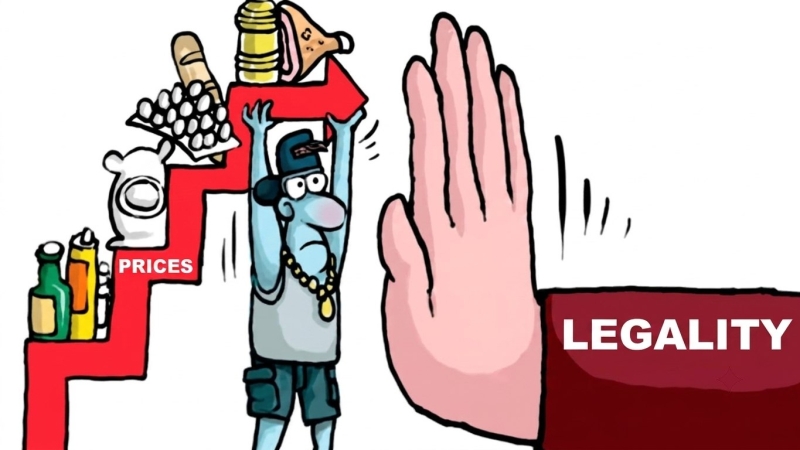
The multiple complaints, arising from an almost ruthless increase in the value of basic necessities on the shelves of private businesses, call for an unavoidable reflection on the reasons for this skyrocketing price of basic foods within the family basket.
It is known that the regulated basket has not fulfilled its purposes for some time, longer than one would wish, and this forces, given the scarce state supply, an irremediable turn toward MSMEs (micro, small, and medium enterprises), local development projects (LDP), and self-employed workers, without including other "exponents" or informal managers.
Thus, therein begins one of the causes of the current phenomenon: the unusual prominence of those who, rather than being interested in a global solution, are only concerned with increasing their monetary pockets, even if it implies sacrifice for others.
I am not generalizing, because there are positive examples, and the curious thing: many will acquire products in those places, no longer to use them for family sustenance, but as a mechanism to take them to other locations and raise their prices. Simply put, to make them more expensive.
It hurts to say it tacitly: to fleece one's fellow man.
The main suppliers, that is, the wholesalers, impose certain rules that complicate distribution, and that is the result of something with many heads, the main one being: the demand for cash payments (reducing the digital aspect to the point of absurdity) and with high-denomination bills.
As a domino effect, given the distorted birth of acquisitions, the rest of the non-state commercial infrastructure applies its own measures, using so many pretexts that they could well constitute the subject of a voluminous literary text.
When one looks for reasons with those same people who dictate "guidelines" in the national domestic market, something stands out: "we do not have government financing to access foreign currency (primarily the dollar) and we have to buy it on the black (informal) market at whatever price is available.
"However, a clarification must be made: the availability of hard currency in the coffers of the Cuban banking system barely allows for covering some expenses, which makes any loan impossible so that these commercial figures can acquire replenishment.
The reluctance of many private individuals to honor their tax obligations makes it impossible, first, for there to be cash in the banks; and second, they almost completely cut off the possibilities of mutually beneficial contacts with national financial organizations, in order to have physical money available for their management.
Nevertheless, regarding this issue of the enormous atomized cost of products in recent weeks, almost without exception, one element cannot go unnoticed: as soon as the salary increase for the budgeted area of the workforce was announced, the prices to be paid for items "suspiciously" began to rise gradually.
It is true that in the world, food prices have increased, and additionally, the unceasing strangulation of the North American blockade makes it difficult, virtually to the point of asphyxiation; however, there are elements that point toward the deliberate objective of taking the largest monetary shares.
Thus, we arrive at the point we stated initially: the cost of costs, which have their own costs. Accounts that affect the consumer, due to a marked appetite for profit, leave the incomes of millions of Cubans exhausted, especially those with lower incomes.
It is not a dead end. Perhaps everything would be less traumatic if there were capital available to stock the markets. Painfully, reality shows another face. And not the most attractive one.
In short, what this is about is seeking positive complicity, and on that path, a comprehensive supervision exercise is currently being conducted, as the goal is to organize and bring within the law those who intentionally want to plunder the modest income of the working class.
These days of work reflect an infinity of legal violations, which have received the consequent treatment in accordance with what is legally established; furthermore, inspections have been used to explain deficiencies and the ways to solve them.
It is no longer about closing shops or applying fines. Ultimately, that is not the desired outcome, because it has been demonstrated that it is feasible to lower prices, many of which reach speculative levels, even exceeding the established margin by as much as 30 percent.
Some chose to close their doors, under the assumption of waiting for the initiated work to conclude. Surely, there will be no shortage of measures against those who intend to mock the process with this mistaken "strategy.
"The country is not looking to block. It seeks to ensure that it is understood, once and for all, that earning a profit is one thing, and profiteering based on collective needs is another.
Meanness and spiritual poverty cannot find sustainable foundations in a nation like Cuba.
Perhaps the expected leap will not be achieved right now. It could be. Nevertheless, it is not a battle of a day, nor of a month. It requires persistence; it requires patience.
Under no circumstances will it be allowed that something, however simple it may seem—and that is not the case—continues to harass the people without having the proper answers.
(Taken from Radio Cadena Agramonte)